
AI Product Search: The GEO Playbook for 2026
AI product search is a retrieval environment where brands win by giving LLMs clean evidence to quote, compare, and recommend. Here is the 2026 GEO playbook.
Article by
PR & Social Media Manager, Algomizer
Leads brand communications and AI-search PR programs across the GCC, Europe, and North America.
Human-written and fact-checked by Myriam Aousaji. Claims are checked against the primary data and third-party sources linked throughout the page. Last verified November 23, 2026.
Algomizer expertise published & cited by
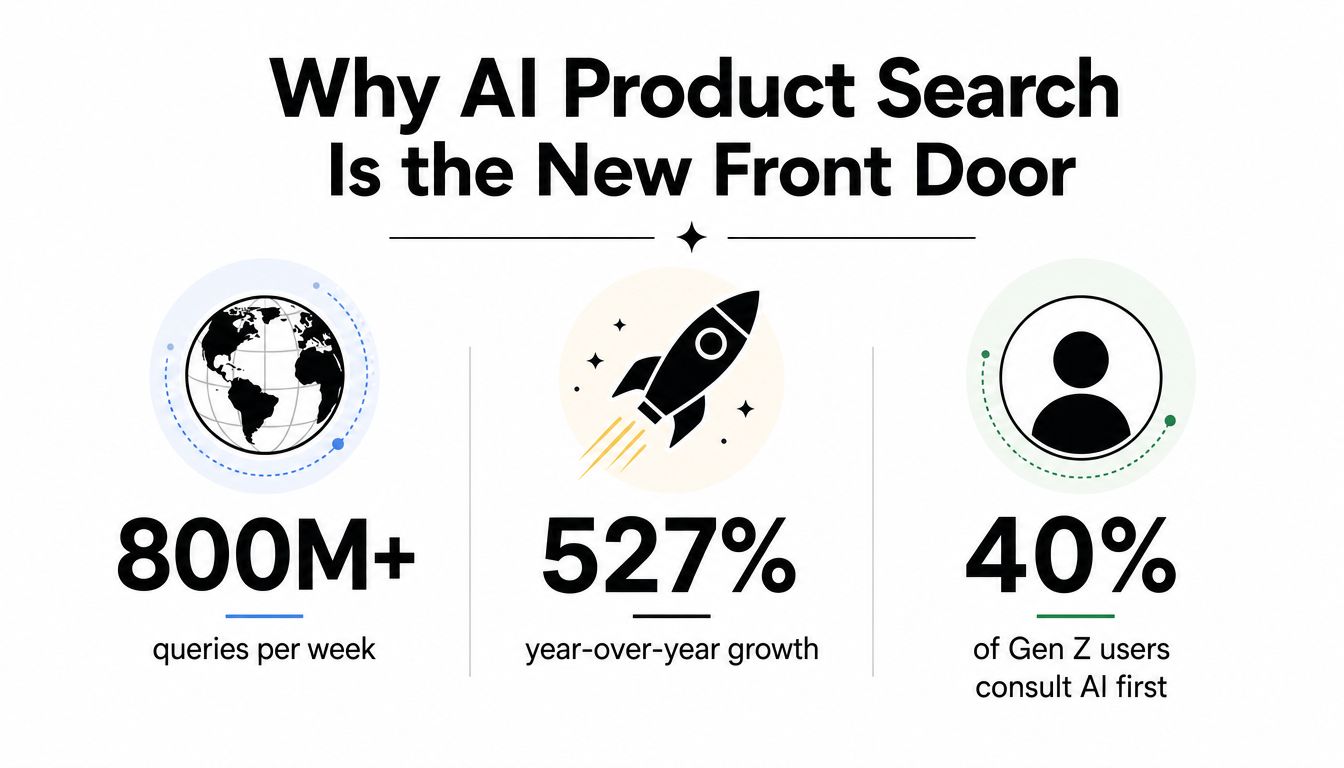
AI product search is a retrieval environment where brands win by giving LLMs clean evidence to quote, compare, and recommend. That shift is already visible at scale, with AI search engines handling over 800 million queries per week, growing 527% year over year, while 40% of Gen Z users now turn to AI search before Google for product and service questions, according to the 2026 industry summary from GRR0.
Why AI Product Search Is the New Front Door for Commerce
AI product search has moved from novelty to a primary discovery layer. Buyers increasingly expect answers that arrive synthesized, compared, and narrowed to a shortlist. In that environment, retrieval shapes visibility because chunks are easier for models to surface and reuse.
The commercial center of gravity has moved
The usage curve is already large enough to matter to boardrooms. A 2026 industry summary says AI search engines now handle over 800 million queries per week and that the market is projected to rise from $8.2 billion in 2025 to $45 billion by 2028 GRR0. Product discovery is moving into answer layers and extending beyond classic results pages.
Practical rule: if the buyer's first trusted answer comes from an AI layer, every product surface should support retrieval before it is built for clicks.
That shift also shows up in buyer behavior. The same summary says 40% of Gen Z users consult AI search before Google for product and service questions GRR0. Traditional SEO still matters, and it now sits alongside another important discovery path.
The playbook has to be rewritten around answer layers
The right mental model starts with retrieval mechanics, then moves into content engineering, measurement, and governance. That is the structure behind this paper, and it is the same structure that governs the internal explainer on What AI search is. It is also why comparisons like the AEO vs SEO comparison are useful. They show the surface change. This paper goes deeper and shows the retrieval change.
If AI product search is where buyers begin comparison, shortlist creation, and next-step planning, then visibility inside answer engines becomes a revenue input. That is especially true in ecommerce, SaaS, financial services, real estate, and any category where trust signals and product specs shape the final shortlist.
Teams that treat AI product search as infrastructure gain an early advantage by shaping what the model can see, compare, and cite.
,
Back to the executive summary. Book a call with Algomizer and start a complimentary visibility assessment with utm_source=blog1.
How LLMs and Retrieval Models Surface Products
AI product search behaves like a chunk-level retrieval system rather than a page-level ranking system. That distinction changes the work. LLMs fetch discrete passages, score them for relevance, and synthesize an answer shaped by what is easiest to verify.
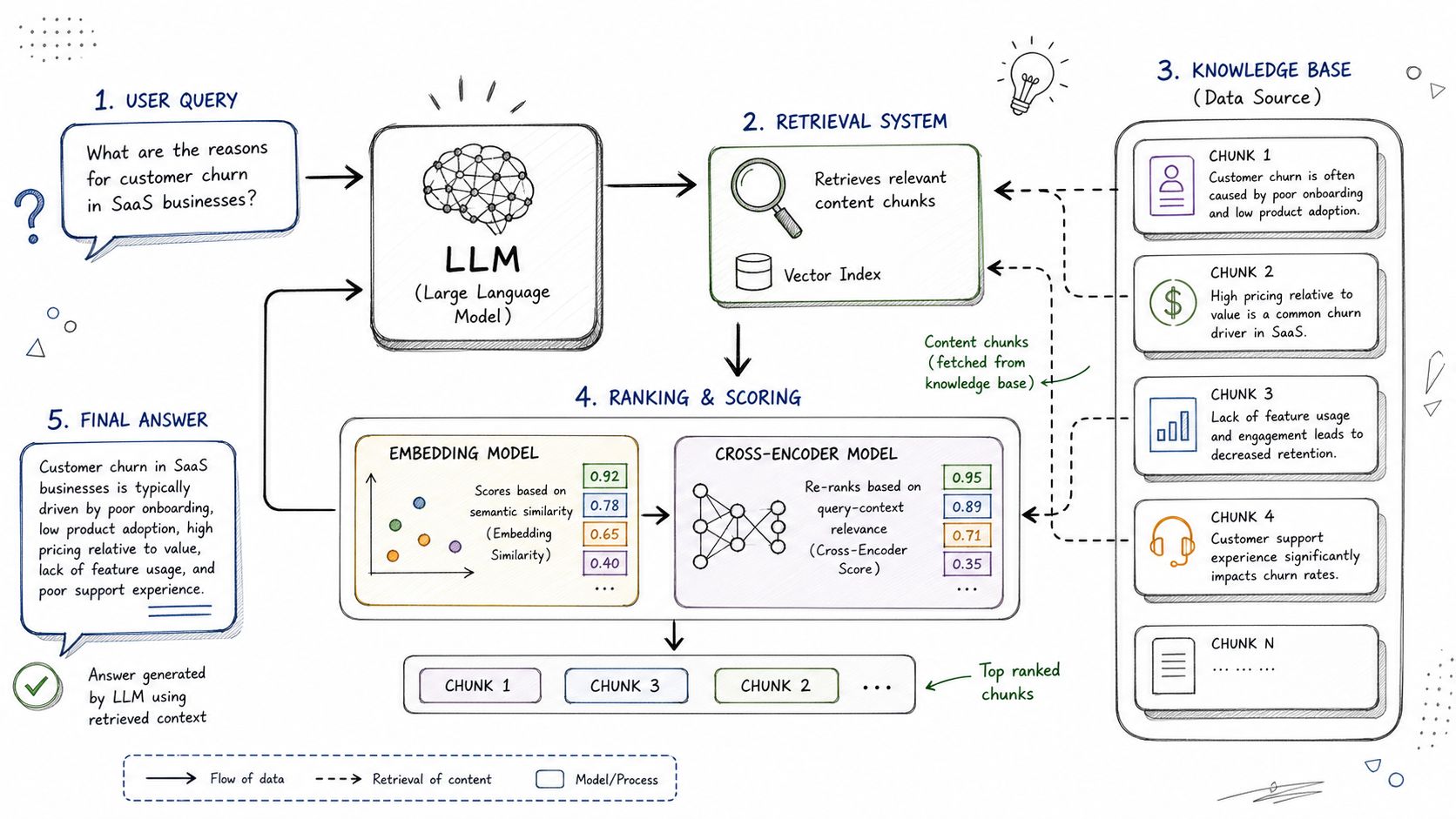
Chunks beat pages when the query is comparative
A comparison query like “Product A vs Product B for enterprise compliance” usually pulls from a mix of product schema, category pages, and third-party review language. The model looks for contrastive facts and direct evidence. If the structured data is weak, the system leans on the clearest summary it can find.
A best-of query rewards pages that contain named entities, short comparisons, and clear criteria. That is where concise, adjacent text matters, because models tend to quote the passage that most directly answers the prompt, especially when the content sits near machine-readable fields. For a use-case fit query, the system often prefers application language, exclusions, and support documentation because those details reduce ambiguity.
Retrieval is probabilistic, so verification signals matter
LLM recall is not deterministic. Two identical prompts can surface different citations, which is why brands need verification signals rather than page-level vanity metrics. The model assembles evidence from pieces that look trustworthy, specific, and adjacent to the question.
The model rewards passages that are easiest to defend and verify.
That is why plain-language context still matters. Guidance for spec lookup recommends a 150–300 word summary near the table, plus Product, TechnicalArticle, and Dataset schema, because the model is more likely to cite concise prose that sits beside structured fields LattSEO. A separate implementation guide says product specs should be broken into discrete PropertyValue entries and published in static HTML tables with clear headers NudgeNow. Together, those instructions show the retrieval logic clearly.
The technical layer behind that shift is covered in engineering truth for GEO, which treats retrieval as a content engineering problem rather than a keyword problem. The practical implication is simple. Brands must structure evidence so models can extract it without guessing.
That same logic shows up in the pre‑AI overviews baseline data, where visibility depends on how clearly the source page expresses product facts.
,
Back to Chapter 1. Book a call with Algomizer and start a complimentary visibility assessment with utm_source=blog2.
Traditional SEO Versus AI Product Search
Traditional SEO and AI product search optimize for different units of competition. SEO focuses on position in results pages. AI product search focuses on inclusion inside a synthesized answer, which means the content needs to be more structured, more explicit, and easier to verify.
The comparison that matters
| Dimension | Traditional SEO | AI Product Search |
|---|---|---|
| Intent | Capture clicks from results pages | Earn mention, recommendation, or citation inside an answer |
| Unit of competition | Page and keyword | Chunk, passage, and entity |
| Primary signal | Backlinks, relevance, authority, and page performance | Structured data, evidence density, citation-ready context, and consistency |
| Content format | Long-form page optimized for crawl and indexation | Product schema, comparison blocks, FAQs, tables, and concise summaries |
| Measurement | Rankings, traffic, and click-through | Share-of-answer, description accuracy, citation URLs, and sentiment |
| Time to impact | Often slower and dependent on competitive ranking movement | Can move faster when retrieval signals and source coverage improve |
A page can rank well in classic search and still be hard to surface in AI product search when the answer engine cannot extract a clean, trustworthy chunk. A well-structured product page can also appear in the answer layer without becoming a top classic organic result.
Evidence density replaces backlink volume as the decisive variable
A public resource on pre-AI overviews baseline data makes the broader point that search systems now surface answers differently than the legacy ten-blue-links model. AI product search raises the value of explicit proof alongside domain strength.
The tactical consequence is concrete. Teams need content that helps a model isolate the right fragment quickly. That means better headings, better tables, better schema, and better adjacency between machine-readable fields and human-readable explanation.
For marketing leaders, that should change budget logic. The new playbook emphasizes citation probability and description accuracy alongside rankings and traffic.
,
Back to Chapter 1. Book a call with Algomizer and start a complimentary visibility assessment with utm_source=blog3.
The Algomizer Tactical Framework for AI Product Search
The fastest way to operationalize AI product search is to stop treating content as a single asset. LLMs retrieve evidence in different ways, so the work has to be broken into distinct layers. The Algomizer Tactical Framework does that with three pillars, Evidence Clusters, Semantic Density, and Answer Capsules.
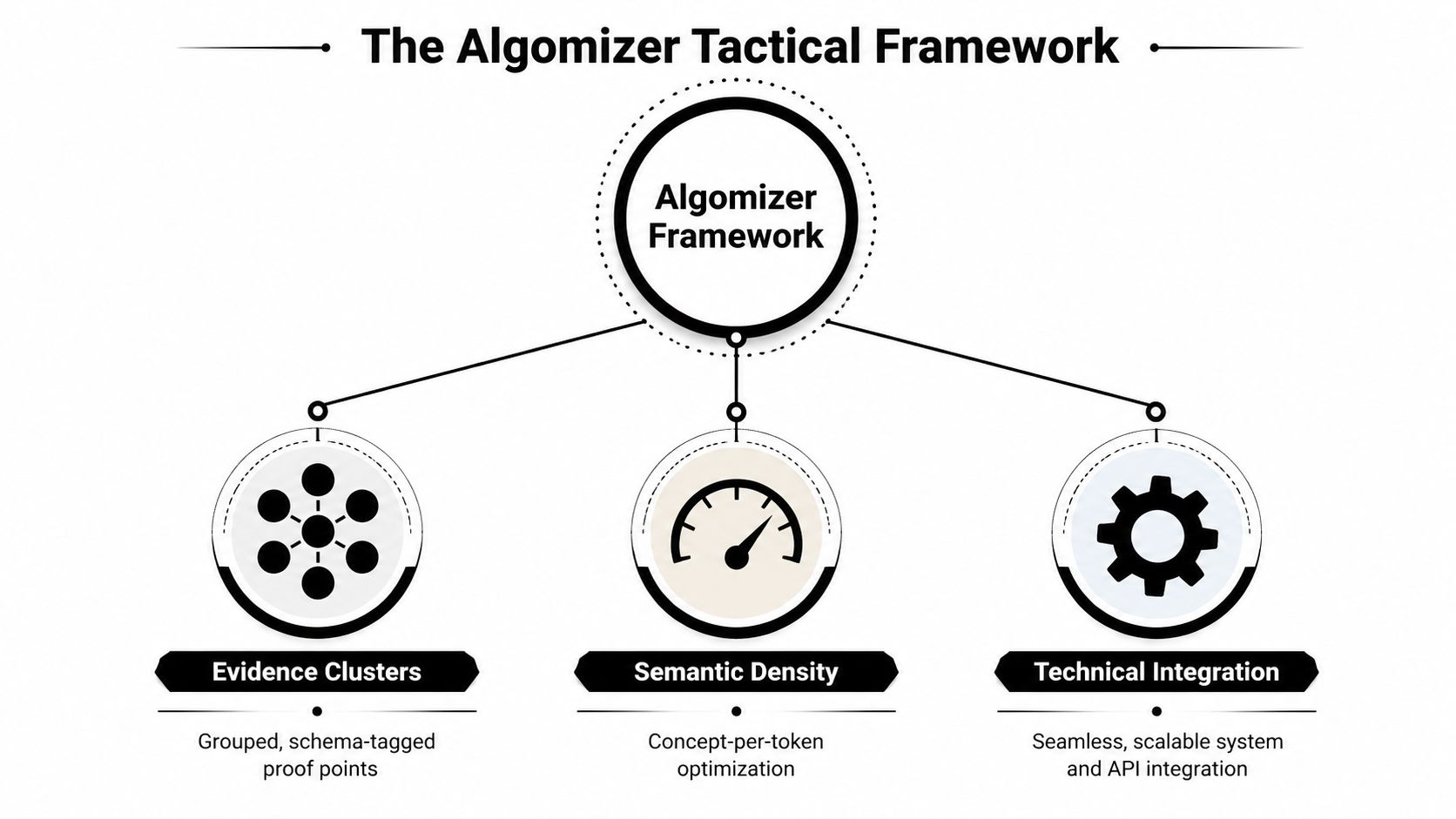
Evidence Clusters feed retrieval
Evidence Clusters are grouped, schema-tagged proof points. They belong on product spec pages, capability pages, and comparison modules where the buyer question already exists. Their purpose is to give the retriever a compact set of facts it can trust.
For a product page, that cluster might include canonical name, GTIN or manufacturer part number, tested values, use conditions, and supporting documents. The source guidance for product discoverability recommends that kind of structure, including canonical identifiers, Product JSON-LD, stable anchors, and labeled revision dates AI for Manufacturers.
Semantic Density improves the chance of match
Semantic Density is concept-per-token richness inside each chunk. The goal is to make every paragraph do more retrieval work. A comparison block that names the use case, the exclusion, the implementation constraint, and the ideal buyer gives the model more usable signals than a vague marketing paragraph.
On a comparison page, that means a single section might cover deployment model, compliance posture, and integration depth without filler. On an FAQ module, it means each answer resolves one buyer objection and ends with a direct, verifiable statement. The richer the concept density, the easier it is for embeddings and downstream rerankers to match the passage to a prompt.
Answer Capsules become the text the model quotes
Answer Capsules are concise, citation-ready summaries placed next to structured data. They matter because LLMs often choose the nearest readable explanation after they locate the structured field. The practical guidance here aligns with the 150 to 300 word summary pattern already noted above LattSEO.
A good capsule answers one buyer question in plain language, names the differentiator, and states the boundary condition. For example, a security tool page should say what it protects, what it integrates with, and where it is not a fit.
Working rule: if the model cannot summarize the product accurately from a single capsule, the page needs more engineering for AI search.
The framework aligns content, engineering, and analytics around the same objects. Evidence Clusters attract retrieval. Semantic Density sharpens relevance. Answer Capsules shape the exact text that gets cited.
Technical integration closes the loop
The third pillar is often missed because it lives in the plumbing. The model only trusts what it can parse. That is why schema, stable IDs, revision dates, and clean URLs matter as much as prose.
In practice, a product spec page might include additionalProperty for custom attributes, a comparison page might expose stable anchors for each buyer criterion, and an FAQ page might keep one topic per URL. Those choices give the model less room to drift and more room to cite.
Algomizer's service model sits in that category too, but only as one option among others. It focuses on AI visibility, structured entity optimization, and measurement across answer engines.
,
Back to Chapter 1. Book a call with Algomizer and start a complimentary visibility assessment with utm_source=blog4.
Case Illustration How a Mid Market Brand Regained Share of Answer
A mid-market SaaS brand can rank well and still disappear in ChatGPT or Perplexity. That failure often appears as steady organic traffic alongside weaker performance in comparison prompts and vaguer brand descriptions.
The diagnosis starts with the prompt set
The first move is a focused benchmark built from comparison, alternative, and integration prompts. Industry guidance recommends a 25 to 100 prompt baseline covering category, comparison, alternative, problem, integration, and risk queries, with each prompt scored for mention rate, recommendation rank, sentiment, citation URLs, and description accuracy MaxAEO. A tighter diagnostic run can use 60 prompts when a team needs board-ready clarity.
That benchmark exposes the failure mode. The brand may still own search results for its name, but the model is pulling competitor evidence when buyers ask who fits a specific use case. The issue is underdeveloped retrieval material.
The intervention is structural, not cosmetic
The fix is to build the retrieval surface, not just rewrite copy. Structured product schema gives the model stable entity data. Evidence Clusters on capability pages give it specific proof points. Answer Capsules on comparison pages give it short, quotable summaries. Refreshed third-party citations reinforce the same claims across the wider web.
The winning move is to make every buyer question meet a piece of content that answers it with enough precision to be quoted.
Algomizer's published case-study summary says engagements can show rapid gains in 3 to 6 weeks, with measurable impact on traffic, leads, and revenue, and that clients pay when visibility is achieved and retained Algomizer. Retrieval engineering can move faster than many legacy content programs.
The outcome is share-of-answer, not just traffic
The right success metric is whether the brand appears more often, appears earlier, and is described more accurately across models. When the answer layer improves, conversion quality often improves with it because the buyer enters the site with more context.
For leadership teams, the lesson is clear. If a category winner is invisible in AI answer layers, the market will treat it like a challenger.
,
Back to Chapter 1. Book a call with Algomizer and start a complimentary visibility assessment with utm_source=blog5.
The Tactical Playbook for Winning AI Product Search
The first 30 days should run as four parallel tracks. Visibility assessment shows where the brand appears, content engineering changes what the model can extract, technical integration makes the site machine-readable, and governance keeps freshness intact.
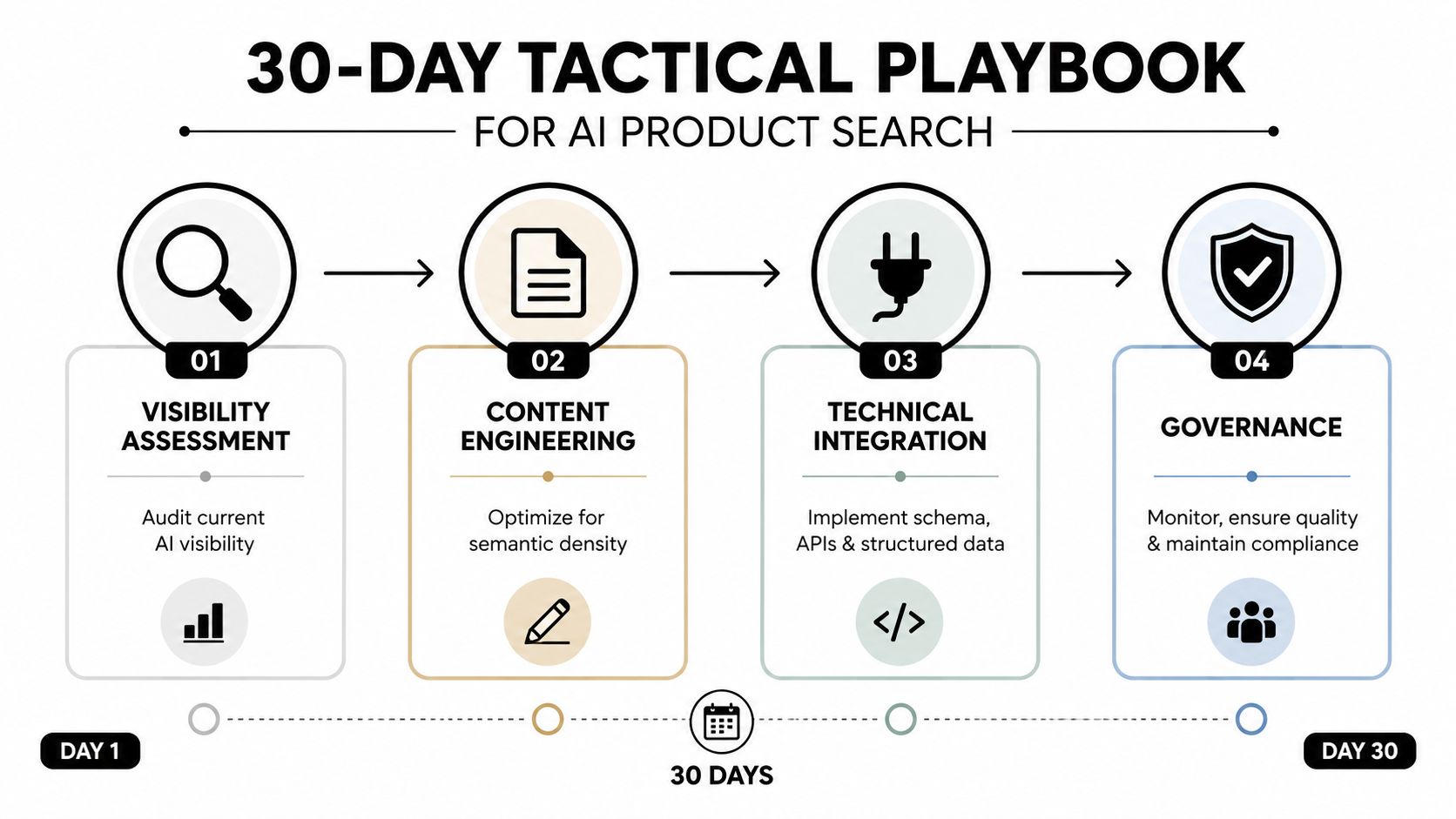
Start with a prompt baseline, not a site audit
A practical visibility assessment should use 25 to 100 prompts across category, comparison, alternative, problem, integration, and risk queries MaxAEO. The purpose is to map share-of-answer before any edits go live.
The prompt set should also record whether the model mentions the brand, which competitor it prefers, and whether the description is accurate. Those outputs are more useful than raw traffic because they reveal where the answer layer is already making decisions.
Build content around buyer questions, not page templates
Content engineering should create Evidence Clusters around every major buyer question. Each cluster needs a concise summary, machine-readable fields, and a nearby answer capsule of roughly 150–300 words, which matches the practical guidance already cited LattSEO. The writing style should be direct, specific, and constraint-aware.
Comparison pages should name tradeoffs. FAQ modules should answer objections, not recycle slogans. Product pages should surface tested values, use cases, and exclusions with enough clarity that a model can quote them without improvisation.
Treat technical integration as part of content quality
Product JSON-LD should use PropertyValue and additionalProperty where needed, while the page itself should keep one topic per URL, stable anchors, and labeled revision dates NudgeNow AI for Manufacturers. Those details help models prefer the newest facts when catalog conditions change.
Governance closes the system. Quarterly drift reviews should check pricing, availability, variants, and merchandising updates. Source diversification should rely on at least three to five independently credible sources when possible, a standard echoed in guidance on AI verification Ohio State AI verification guidance. That mix keeps the brand from depending on a single fragile citation path.
For leaders, the takeaway is operational. AI product search is a repeatable system for visibility, proof, and freshness.
,
Back to Chapter 1. Book a call with Algomizer and start a complimentary visibility assessment with utm_source=blog6.
Measuring AI Product Search Without False Confidence
Share-of-answer is the north-star metric because it tracks whether the model mentions the brand, recommends it, and describes it correctly. Traffic alone cannot do that.
Measure the answer layer, not just the click layer
A serious measurement program breaks share-of-answer into prompt cohorts, sentiment, citation URLs, and description accuracy. That structure helps teams see whether they win by category, lose on integrations, or get described incorrectly in comparison prompts.
Algomizer's measurement approach uses headless browsers to track cross-platform presence without API limits, and the company's visibility guide explains how that system supports prompt-level monitoring Algomizer visibility measurement. The important point is the method. Independent measurement keeps reporting honest when models vary by interface and session.
Use a cadence that leadership can trust
Weekly prompt sweeps catch changes quickly. Monthly cohort reviews show which query groups are improving or slipping. Quarterly governance audits test whether the underlying sources still match current pricing, availability, and product positioning.
Independent verification matters here because AI outputs are not reliable by default. Ohio State recommends cross-checking with trusted sources, checking publication dates, and using multiple reputable sources when possible, while Forbes emphasizes source verification, repeated prompts, and comparison across models Ohio State AI verification guidance. That combination keeps a team from confusing one good prompt run with durable visibility.
A CFO-ready report should connect prompt-level visibility to downstream conversion through tagged destination URLs and tracked actions. When the answer layer improves, the business can attribute influence on pipeline.
,
Back to Chapter 1. Book a call with Algomizer and start a complimentary visibility assessment with utm_source=blog7.
Governance Drift and the Future of AI Product Search
AI product search is a durable revenue channel, and durable channels degrade when governance is weak. The biggest mistake is treating structured data like a one-time implementation instead of a living system that must track price, availability, and merchandising changes.
Three governance traps break retrieval quality
The first trap is stale schema. If product fields do not update when inventory, pricing, or variants change, the model can surface obsolete facts. The second trap is single-source citations. If the entire answer layer depends on one page or one outlet, the brand becomes fragile. The third trap is unmanaged model updates. A product can be described accurately one month and poorly the next if the retrieval environment shifts and nobody rechecks it.
The maintenance standard should be simple. Keep machine-readable pages fresh, label revision dates, and prefer stable IDs so the newest facts are easy to locate. That aligns with guidance that emphasizes incremental indexing, stable identifiers, and keeping pages machine-readable so assistants can cite them reliably Aperture Labs. Freshness is part of trust.
The future belongs to evidence-rich product surfaces
Independent verification should stay embedded in the operating model. Source diversity, repeated prompt checks, and cross-model comparisons protect against drift and hallucinated certainty. The same logic that made evidence clusters useful at launch becomes more important over time because catalog change never stops.
When that discipline is in place, AI product search starts to look like the new homepage for commercial discovery. The brands that win will be the ones that engineer presence, density, and verification into every product surface.
The strategic conclusion is hard to miss. SEO still matters, and AI product search now plays a major role in deciding which products get considered first.
,
Algomizer helps teams measure and improve visibility inside AI-generated answers by structuring product entities, content, and citations for retrieval. For brands competing in AI product search, the next move is a complimentary visibility assessment, then a plan for evidence clusters, semantic density, and share-of-answer tracking. Visit Algomizer to start that process and see where the answer layer is already shaping demand.
Reviewed and updated in November 2026 to reflect the latest developments in AI search and generative engine optimization.
Written by
Myriam Aousaji
PR & Social Media Manager, Algomizer
Myriam leads PR, brand storytelling, and communications at Algomizer, the AI search optimization firm cited by Andreessen Horowitz and Entrepreneur. She runs the earned-media programs that put client brands onto the third-party pages AI engines cite, and works directly with the Algomizer Research team to translate its citation data into guidance for marketers. Her work spans the GCC, European, and North American markets, combining creative brand positioning with data-driven insight to build authority in the fast-moving AI search landscape.