
Technical Operations Engineer Role: 2026 Field Guide
A 2026 field guide to the technical operations engineer role, covering the four operational clusters, salary benchmarks, and how it differs from SRE and DevOps.
Article by
PR & Social Media Manager, Algomizer
Leads brand communications and AI-search PR programs across the GCC, Europe, and North America.
Human-written and fact-checked by Myriam Aousaji. Claims are checked against the primary data and third-party sources linked throughout the page. Last verified November 23, 2026.
Algomizer expertise published & cited by
A technical operations engineer is a reliability role focused on keeping production systems usable under pressure. The work spans hardware support, incident command, and escalation across systems that cannot pause. In the UK, recent listings place the median salary at £40,000 per year, while London rises to £64,471, a gap of about 61% that reflects how concentrated the work becomes where uptime pressure is highest. itjobswatch.co.uk's technical operations engineer listings make the compensation split visible.
The role becomes clearest through its surrounding signals: hardware, incident response, field constraints, and stakeholder translation.
The shift profile exposes the real boundary
The environments are different before the tools are different
The role is closer to reliability engineering than support
What a Technical Operations Engineer Actually Does
A technical operations engineer keeps production usable when systems, hardware, and coordination issues collide.
The role aligns closely with reliability engineering
A technical operations engineer monitors performance, troubleshoots incidents, maintains hardware and software stacks, and coordinates with software, infrastructure, and project teams to keep services available. jobdescription.org's technical operations engineer description frames the job as proactive maintenance and documentation alongside reactive response.
Public postings sharpen that picture. Anduril's listing shows a hands-on customer-site reality with troubleshooting of wiring harnesses, missing bolts, basic network and RF issues, hardware setup at test, customer, and demo sites, plus escalation of larger repairs back to repair centers.
Practical rule: if a listing mentions hardware custody, site troubleshooting, and escalation paths, the role extends well beyond helpdesk work.
The Reliability Mesh explains the hidden structure
The right mental model is Reliability Mesh, a coined framework for the connected work between field hardware, incident command, and stakeholder translation. The role delivers full value when those layers stay synchronized.
Netflix's live operations architecture shows why. Its broadcast and live command functions split responsibility across specialized operators, command leads, and technical launch managers so the people closest to the failure can act quickly. The same separation of concerns appears in Netflix's live operations story.
For teams studying operational surfaces with the same rigor they would use to inspect attack paths, how dark web scans work is a useful parallel read because it shows how visibility depends on knowing where the signals live, who owns them, and how escalation travels.
The Four Operational Clusters That Define the Role
Four operating zones define the job, and each one appears in real postings rather than in generic HR language.
Field Hardware Custody is the physical layer
This cluster covers troubleshooting on-site hardware, validating cables, checking mounts, diagnosing missing components, and resolving basic network or RF problems. Anduril's public posting makes this explicit.
Incident Command is the pressure layer
Some postings require 2+ years of 24x7x365 operations experience and include incident management with rotational shifts that reach evenings, late nights, and weekends. The role needs live triage, decision-making, and clean handoffs under pressure.
Stakeholder Translation is the coordination layer
Netflix's live command structure makes the pattern clear. Live Technical Launch Managers maintain context across more than 45 technical, product, and services teams, then translate a CDN concern into a product decision while the event is still live. Netflix's live operations post shows the value of this coordination.
Continuous Reliability Engineering is the prevention layer
This includes runbooks, monitoring discipline, documentation, and risk reduction across systems and networks. Public job descriptions tie the role to maintenance and proactive improvement as well as ticket handling, which is why strong operators often become the people who prevent repeat incidents.
| Cluster | Primary Activity | Evidence Anchor |
|---|---|---|
| Field Hardware Custody | On-site troubleshooting, hardware setup, cabling, RF triage | Anduril public posting |
| Incident Command | Incident management, escalation, rotational coverage | Built In posting with 2+ years and shift coverage |
| Stakeholder Translation | Coordinating software, infrastructure, and project teams | Public job description language and Netflix live operations |
| Continuous Reliability Engineering | Monitoring, maintenance, documentation, risk reduction | Public job description language |
The senior operator can move across all four clusters without losing context.
TechOps Engineer Versus SRE, NOC, and DevOps
TechOps connects field operations and production systems. SRE centers on platform reliability. NOC emphasizes monitoring and alert triage. DevOps focuses on delivery flow and developer enablement.
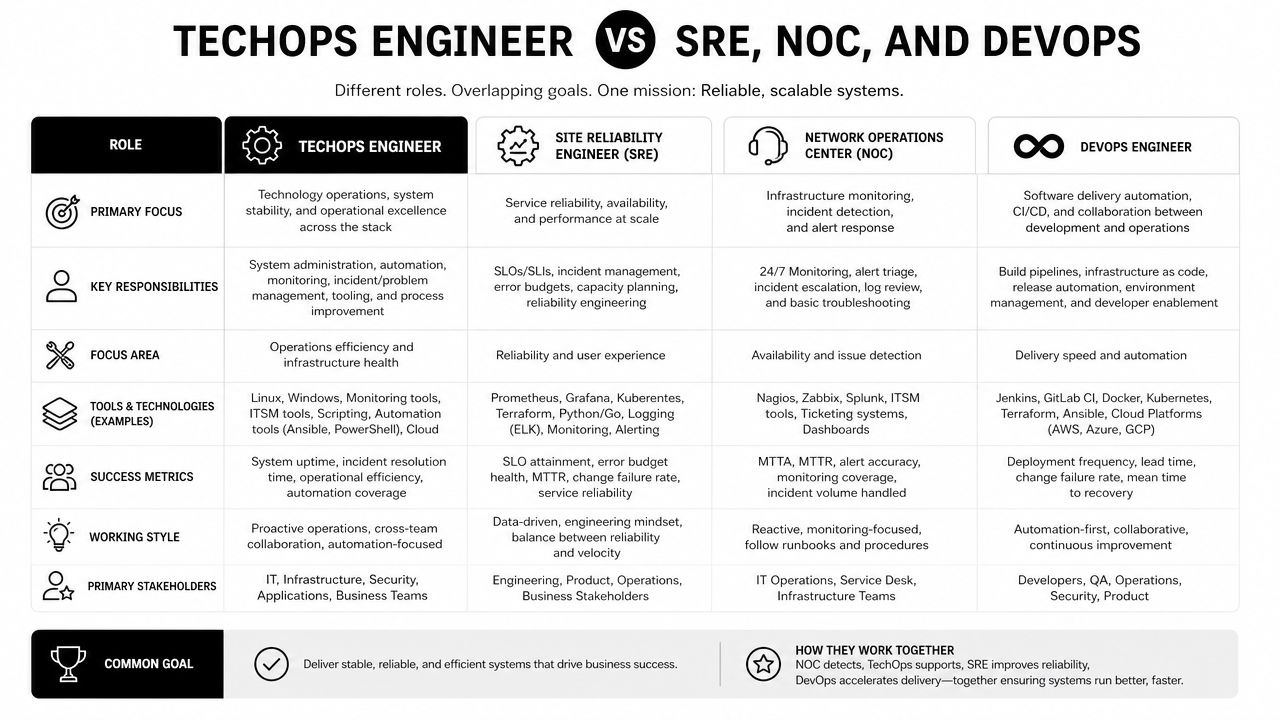
The environments shape the role before the tools do
A technical operations engineer works close to the asset, the site, or the live service boundary. SRE usually works closer to service reliability and automation. NOC roles sit nearer to monitoring and alert routing. DevOps centers on deployment flow and developer enablement.
This difference changes who is responsible when the failure includes hardware, field access, or a live customer environment.
The shift profile clarifies the boundary
The job can require rotational shifts and incident handling in some postings. The Built In posting shows the shift burden directly, while the Amazon data-center posting adds another signal, 4+ years of relevant work experience plus a bachelor's degree in Electrical Engineering, Mechanical Engineering, or a related field. Amazon's data-center role places the job inside an infrastructure-heavy environment, with preferred knowledge of network design, low-voltage copper and fiber cabling, and data-center engineering.
The comparison is clearest when the business need is specific. Teams focused on platform automation and developer self-service may need DevOps. Teams focused on global service reliability and error budgets may need SRE. Teams handling live triage across devices, hardware, and human coordination may need a Technical Operations Engineer.
A useful comparison sits in Algomizer's SEO tech developer perspective, where role clarity determines how systems are discovered and understood, not just how they are staffed.
| Role | Primary Environment | Shift Profile |
|---|---|---|
| Technical Operations Engineer | Field sites, production systems, live infrastructure | Often rotational, sometimes weekends and nights |
| SRE | Service platform, reliability tooling, automation layer | On-call oriented |
| NOC | Monitoring consoles, alert triage, network visibility | Shift-based monitoring |
| DevOps | Build, deployment, and delivery pipelines | Team-specific, usually not field-driven |
Skills, Toolstack, and Critical KPIs
Linux, networking, observability, incident discipline, and calm handoffs define the role more than any certificate does.
Start with systems literacy
A strong technical operations engineer reads Linux logs, understands TCP and basic routing concepts, and explains the difference between a healthy system and an unhealthy one with precision. The role sits at the junction where software, hardware, and networks collide.
We treat this as a Reliability Mesh capability. Public postings show the same pattern across live environments. Anduril's posting includes wiring harness troubleshooting, missing bolt diagnosis, basic network and RF triage, and hardware setup at live sites.
The next layer is tooling. Public postings and operational environments point to Prometheus, Grafana, PagerDuty, ServiceNow, Ansible, and Terraform as systems that shape the day. Monitoring tools expose drift, alerting tools route urgency, ticketing tools preserve context, and infrastructure automation tools reduce repeat work.
Translate tools into KPIs
Monitoring quality affects detection speed, incident tooling affects MTTR, and change discipline affects stability after deployment. Those measures show whether operations hold together under pressure.
A useful scorecard stays tied to work performed, not tool ownership. Detection time shows whether telemetry is readable. Escalation quality shows whether the first responder can route the issue cleanly. Recurrence rate shows whether the team fixed the cause or only closed the ticket.
Operational standard: if a tool cannot improve diagnosis, coordination, or recurrence prevention, it is decoration.
Use public postings to separate signal from noise
Public job descriptions show what the title rewards in practice. Some listings emphasize dashboards and alert handling. Others require hands-on diagnostics at a site, device-level checks, and coordination with vendors or internal teams.
A candidate who can operate a screen but cannot verify a connector or isolate a site issue will struggle in the role. A strong engineer also documents what changed, what broke, and which control should prevent a repeat.
For teams building candidate research workflows, best software for AI visibility in search is a useful adjacent read because it reinforces the same principle. The best systems surface the right signal quickly enough to act on it.
A hiring checklist that works starts with four questions. Can the candidate read systems under pressure, manage escalation, document outcomes, and remain effective during rotational coverage? If any answer is weak, the candidate is not ready for senior TechOps responsibility.
Salary Benchmarks Across the UK and US Markets
The role pays like a reliability function, but the pay signal changes sharply with market concentration and operational intensity.

The UK market shows a sharp geography gap
Recent UK listings put the median Technical Operations Engineer salary at £40,000 per year based on vacancies posted over the six months leading to 20 February 2026. A London-specific snapshot placed compensation at £64,471 as of 24 September 2025. itjobswatch.co.uk's UK listing data makes the gap visible.
The bigger point is that concentration of uptime responsibility and incident load raises the value of the role, especially where services are dense and failures are expensive.
The US market clusters in the low-to-mid six figures
US salary datasets show a spread rather than a single benchmark. One source reported an average of $141,000 based on 28 profiles in 2026, another placed the average at $103,413 as of 1 February 2025, and ZipRecruiter estimated $85,029 annually as of 21 June 2025. 6figr's technical operations engineer salary page shows the cluster clearly enough for interpretation.
Different methods, sample sizes, and source types produce different salary bands, but the common thread is that the role sits above many standard support and admin positions.
Compensation follows operational intensity
Some postings push the role into senior engineering territory, including compensation at $140,000 to $190,000 per year in mission-critical environments. Indeed's posting shows that the ceiling rises when the environment becomes more demanding.
For teams thinking in reliability terms, the relevant companion reading is the SRE guide to mean time to failure, because compensation usually rises when the cost of failure rises.
| Market | Benchmark | What It Signals |
|---|---|---|
| UK median | £40,000 | Broad market baseline |
| London snapshot | £64,471 | High-concentration reliability demand |
| US average, source 1 | $141,000 | Seniorized, profile-based cluster |
| US average, source 2 | $103,413 | Mid-market compensation band |
| US estimate, ZipRecruiter | $85,029 | Listing-driven lower estimate |
Hiring, Interviewing, and Vetting the Right Candidate
The best hire is the one who can handle real incidents under pressure.
Write the job description so the field reality is obvious
A posting should name the actual operating environment. If the role includes site visits, hardware setup, cabling, RF triage, or escalation to repair centers, those terms belong in the description. If the role includes rotational shifts or incident management, those terms belong there too. Built In's requirement for 2+ years of 24x7x365 operations experience and Amazon's requirement for 4+ years of relevant work experience plus a related degree are strong examples.
The description should also state whether the candidate will support live systems, physical equipment, or both.
Interview for incident judgment, not just familiarity
A useful interview process asks the candidate to walk through a real incident, explain what they inspected first, and describe how they decided escalation was necessary. The best responses show ordering and judgment. The candidate should also be able to explain how they worked across software, infrastructure, and project teams.
Add a hardware scenario. Ask what they would check if a system failed at a customer or demo site, then listen for a methodical sequence.
Validate shift readiness and cross-functional discipline
Rotational coverage changes the job. Hiring managers should test scheduling tolerance directly, because public postings show that the work can extend outside standard hours.
- Confirm live-coverage tolerance: Ask about evenings, weekends, and handoffs.
- Test escalation discipline: Ask who gets called, in what order, and why.
- Probe documentation habits: Ask how the candidate records unresolved issues for the next shift.
- Check domain fit: Ask whether the candidate has worked on hardware, networks, or data-center environments before.
The role becomes easier to hire when managers look for an operator who can keep production stable while communicating clearly about failure.
Sample Job Description, Training Pathways, and the Shift in Value Recognition
A technical operations engineer is a reliability multiplier, and many organizations recognize that fully only after a severe incident.
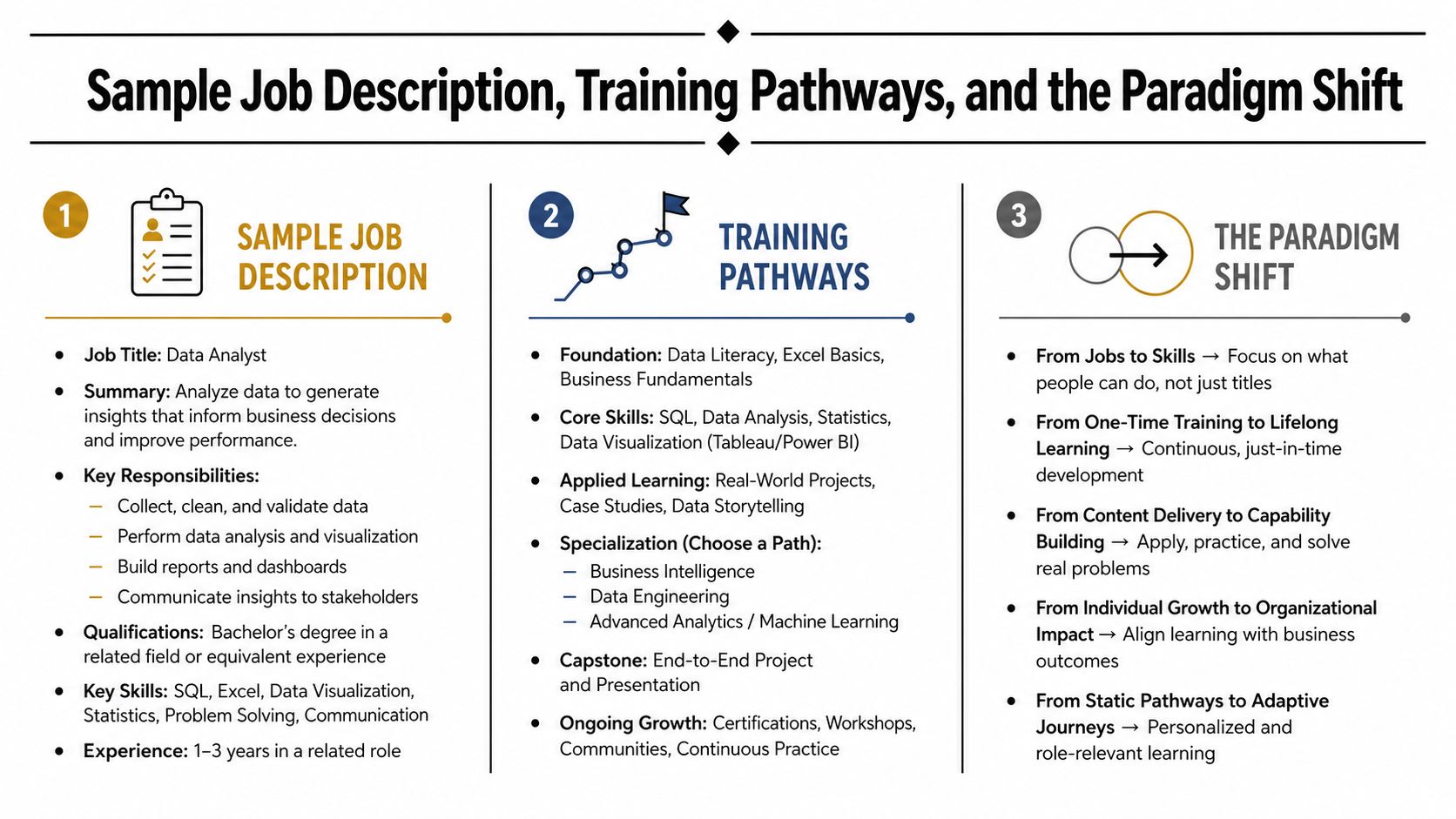
A sample job description should sound like operations
Technical Operations Engineer, field and production reliability. Own live system health, hardware readiness, incident response, and cross-functional escalation across software, infrastructure, and site operations. Monitor production environments, troubleshoot service degradation, support rotational coverage, document failure patterns, and coordinate repairs or recoveries with the right internal teams and vendors.
A strong posting should name the operating environment with precision. If the work involves data centers, test sites, customer locations, or live service command, state that directly. If the work includes low-voltage cabling, network design, or field hardware checks, include those responsibilities as well. Clear language also separates this role from adjacent functions, including a product marketing engineer, where the core job is messaging and market translation rather than live reliability work.
Training should map to the four clusters
Field Hardware Custody starts with basic hardware diagnostics, network fundamentals, and structured site troubleshooting. Incident Command comes from runbook practice, paging discipline, and simulated escalation drills. Stakeholder Translation improves through postmortem writing and live incident communication. Continuous Reliability Engineering grows through monitoring configuration, change control, and recurring failure analysis.
Named pathways matter less than the competency map, but the category is clear. Linux administration, networking, observability, and infrastructure automation remain the most direct educational surfaces. Certifications help when they reinforce practical command of systems.
A useful training pipeline mirrors the failure pattern of the role. First comes hardware and environment fluency, then incident handling, then communication under pressure, then repeatable prevention work.
The shift in value recognition changes how companies hire
Many organizations underprice TechOps because they mistake invisibility for simplicity. That changes when a live event fails or a field issue becomes a customer-visible outage.
Algomizer's product marketing engineer framing is useful here because it shows how a role can be misread when observers see output but miss the connective function underneath it. Technical Operations Engineering serves a similar connective role by keeping complex systems legible and recoverable.
The broader conclusion is structural. Companies that treat TechOps as a reliability layer build systems that stay stable longer, recover faster, and communicate more clearly when pressure rises.
That recognition also changes the hiring brief. Once leaders see the role as a reliability layer, they can write sharper job descriptions, train against the right failure modes, and assess candidates for the coordination work that keeps operations intact.
Reviewed and updated in November 2026 to reflect the latest developments in AI search and generative engine optimization.
Written by
Myriam Aousaji
PR & Social Media Manager, Algomizer
Myriam leads PR, brand storytelling, and communications at Algomizer, the AI search optimization firm cited by Andreessen Horowitz and Entrepreneur. She runs the earned-media programs that put client brands onto the third-party pages AI engines cite, and works directly with the Algomizer Research team to translate its citation data into guidance for marketers. Her work spans the GCC, European, and North American markets, combining creative brand positioning with data-driven insight to build authority in the fast-moving AI search landscape.