
Competitive Ad Monitoring That Actually Wins in AI Search
Competitive ad monitoring is a signal-detection discipline. Learn the four observable fields, the KPI stack, and how ad persistence shapes AI citation share.
Article by
PR & Social Media Manager, Algomizer
Leads brand communications and AI-search PR programs across the GCC, Europe, and North America.
Human-written and fact-checked by Myriam Aousaji. Claims are checked against the primary data and third-party sources linked throughout the page. Last verified November 23, 2026.
Algomizer expertise published & cited by
88.7% of tracked ads disappear within 60 days. That makes competitive ad monitoring a signal-detection discipline, because the surviving 11.3% show what a rival continues to support in market and what it has learned to trust (Segwise).
Competitive ad monitoring now informs AI search visibility. Large language models benefit from durable evidence, recurring message patterns, and cross-channel consistency that can be re-derived across retrieval events. The practical question is which ad signals persist long enough to shape how AI systems recall, rank, and cite a brand.
That shift raises the value of longevity, abandoned clusters, and transparency surfaces. For teams in major markets, the strongest approach is to treat competitor ads as a structured evidence feed, then turn that feed into AI-search decisions and PPC analysis.
Why Competitive Ad Monitoring Is Now an AI-Search Problem
Paid search creatives are highly ephemeral, and that volatility changes what analysts should treat as signal. Ads that remain visible long enough to recur deserve more attention, because durable ads often reflect a defended query position, a tested message, or a budgeted push that a rival chose to keep in market.
The Data Churn Problem
Competitive ad monitoring once centered on checking a rival's newest search ad and saving the screenshot. That workflow overlooks a more useful layer of the market. When ads disappear quickly, the freshest creative often reflects experimentation, while persistent messages show what a competitor continues to fund.
That shift matters because competitive ad monitoring now feeds the evidence layer that AI search systems read from. Retrieval systems tend to reward repeated entity patterns, consistent message structures, and landing-page corroboration. A brand that keeps showing the same offer framing across time becomes easier for systems like ChatGPT, Claude, Gemini, and Perplexity to encounter as a stable source of meaning.
A useful starting point is the guide to PPC competitive tracking, but the AI-search lens changes the standard for evidence. The goal is to identify what persisted and how those patterns repeated over time.
Why Screenshots Fail LLM Retrieval
Screenshots freeze one moment. LLM-style retrieval depends on patterns that remain visible across time and surfaces, then get reinforced by repetition.
Practical rule: if an ad can't be tied to its first-seen date, duration, and landing-page destination, it is only a fragment.
That logic lines up with the broader shift described in What AI Search Means for Marketers. Competitive ad monitoring produces recurring facts that AI systems can triangulate, while isolated screenshots often remain disconnected from decision-making.
Defining Competitive Ad Monitoring Through Four Observable Fields
Competitive ad monitoring is the systematic capture of four observable fields, query, creative, landing page, and duration. That definition is operational because each field gives an AI system a different kind of retrievable evidence.
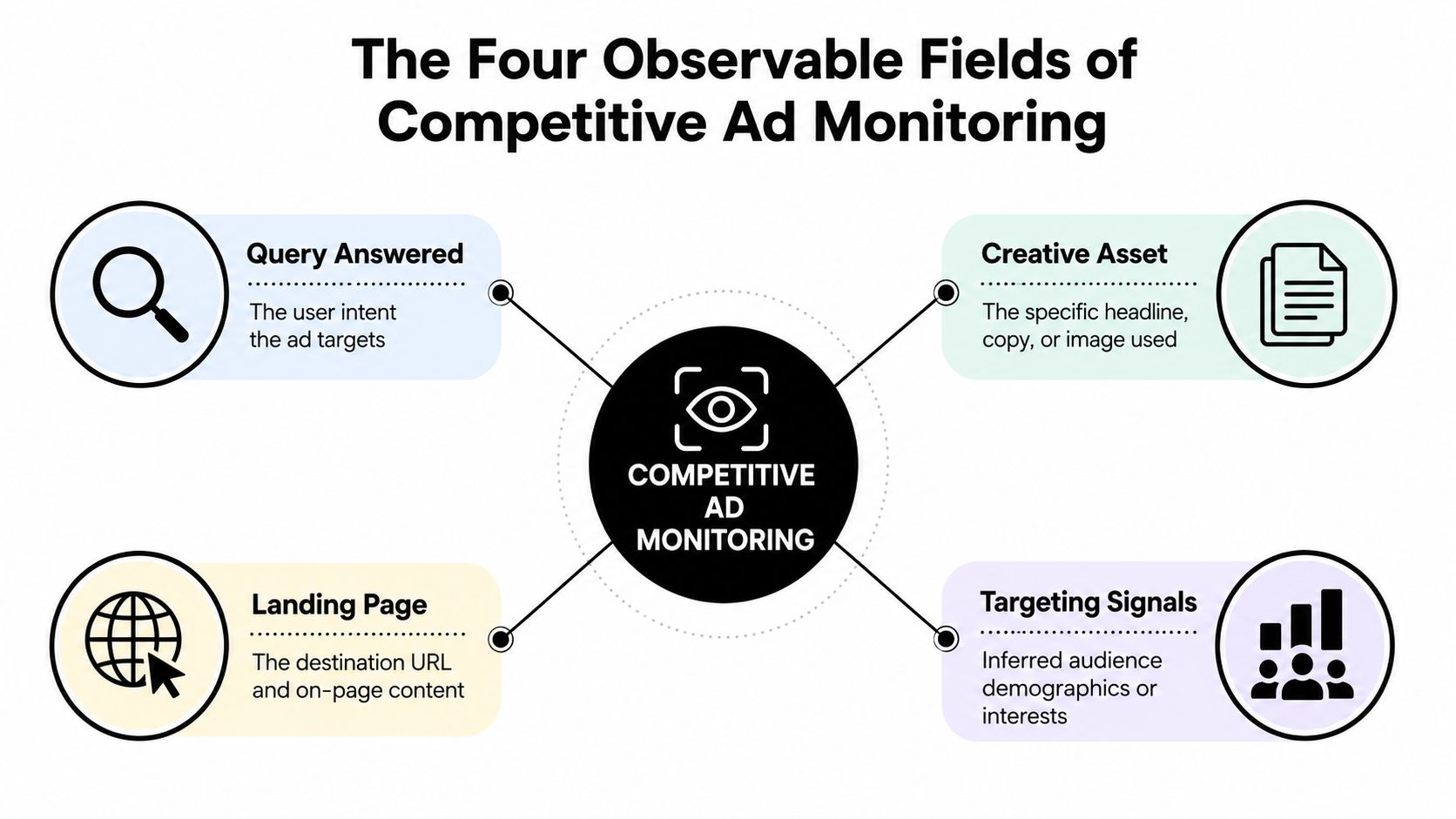
The Four Fields Analysts Must Capture
The query shows the intent the rival is answering. In search advertising, that means the keyword set, the problem framing, and the commercial moment the ad is trying to capture.
The creative shows the message the competitor chose to run in public. Headline structure, offer framing, and call to action reveal positioning choices that can be compared across repeated appearances.
The landing page shows whether the ad and the destination agree. That congruency is a high-value signal because a strong message usually keeps its promise after the click, while a weak one often fragments at the page level.
The duration shows whether the ad survived. Survival is a confidence signal, because a long-running ad suggests the market tolerated it, responded to it, or at least allowed budget to keep flowing.
| Observable field | What it reveals | Why it matters for AI retrieval |
|---|---|---|
| Query | User intent and market demand | Helps systems infer the problem space |
| Creative | Message and offer framing | Surfaces brand voice and positioning |
| Landing page | Entity consistency and promise delivery | Confirms whether the ad and page align |
| Duration | Performance confidence | Separates durable signals from short tests |
A junior analyst can use that table as a day-one brief. Screenshot collection tells the team what existed. Structured evidence capture gives the team a clearer view of what it meant.
The KPI Stack That Predicts a Rival's Bid Posture
The strongest competitive ad monitoring stack ranks seven KPIs by diagnostic power. Auction indicators show who is fighting, longevity shows who is sustaining a message, and creative variation density shows who is still testing.
A Tiered Metric Stack
Impression share is a clear signal of defensive intent in Google Ads environments, because it points to visibility pressure around a query set.
Overlap rate and position-above rate show whether the rival is appearing in the same searches and whether that rival is winning higher visibility when both ads surface.
Ad longevity is especially useful when the goal is to infer confidence. A long-running ad suggests a message that survived enough internal review and market exposure to remain active. The same persistence matters for AI retrieval, since repeated public exposure gives systems more chances to attach the offer to the brand in future citation behavior.
Creative variation density points to testing intensity. A high number of parallel variants usually means budget is being allocated toward figuring out what deserves scale. It also hints at how much the rival is still trying to shape how its message will be read across surfaces, including the public record summarized in how ChatGPT gets its information.
The remaining signals sharpen the read. Landing-page congruency checks whether the promise holds after the click. Abandoned-cluster ratio measures how many creative families died versus survived. Cross-channel consistency matters here too, and the same scrutiny applies in ad verification workflows such as why Sota Proxy for ad verification, where matching public signals to live execution is the point.
| KPI | What it signals | Best for |
|---|---|---|
| Impression share | Defensive visibility pressure | Query defense analysis |
| Overlap rate | Shared auction presence | Competitive keyword mapping |
| Position-above rate | Who wins visibility | SERP aggression checks |
| Ad longevity | Message confidence | Winning creative identification |
| Creative variation density | Testing intensity | Budget allocation inference |
| Landing-page congruency | Offer integrity | Post-click consistency review |
| Abandoned-cluster ratio | Failed themes versus surviving themes | Pattern validation across rivals |
When review time is scarce, prioritize longevity first, then auction indicators, then variation density. That order helps analysts separate durable signals from temporary noise.
Channel Surfaces and Where LLMs Read Ads
LLMs read the most verifiable ad surfaces first, then generalize from recurring ones. Transparency tools are especially valuable because they expose current ads, dates, links, and observable metadata.
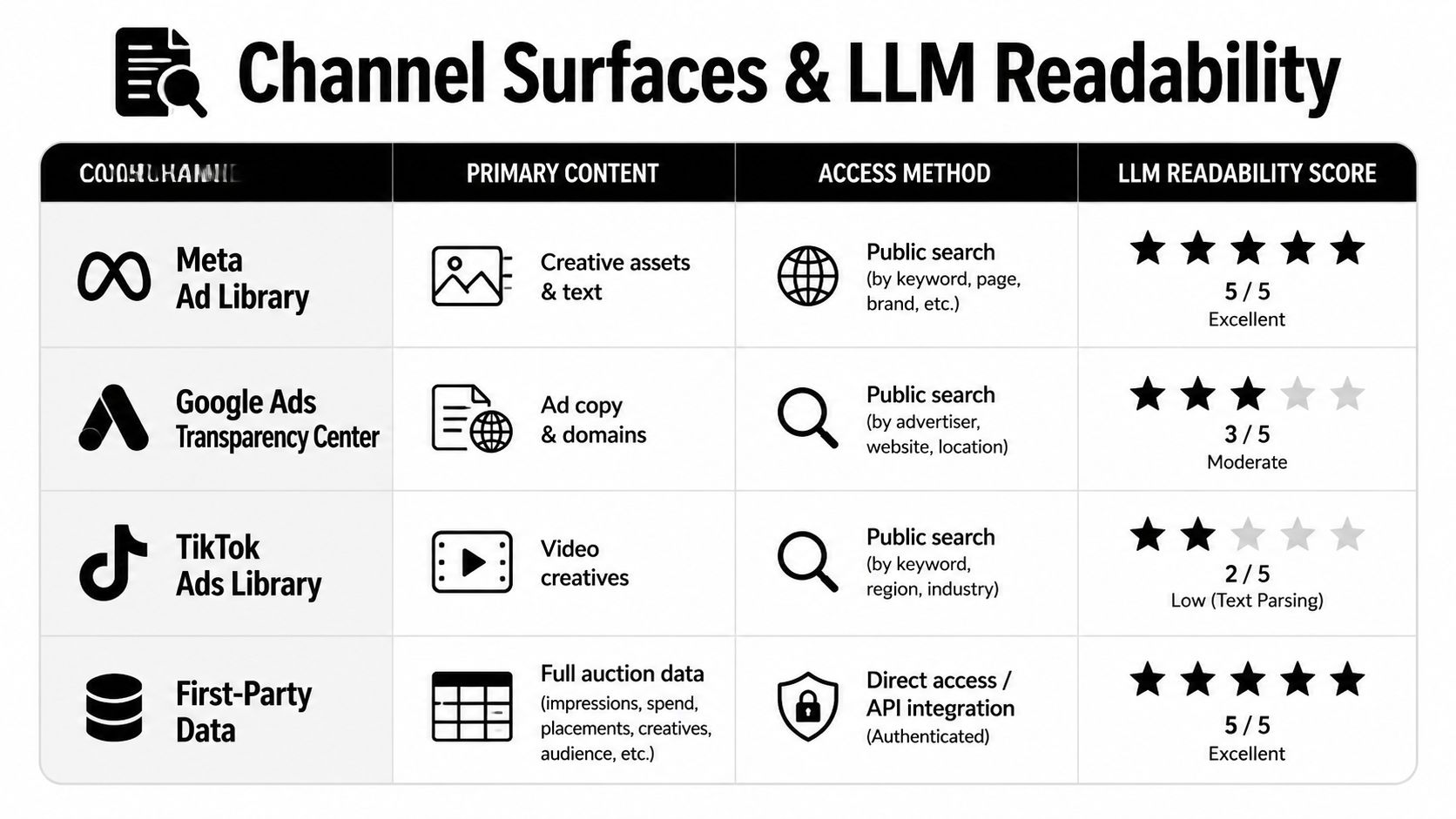
Transparency Tools Versus Auction Data
Meta Ad Library is one of the clearest surfaces because it exposes live creative and copy in a public review flow.
Google Ads Transparency Center matters for the same reason, but with search-first relevance. It exposes searchable advertiser information across Google surfaces, which makes it useful for confirming active campaigns and tracing where the message points. That matters because search-ad signals are often reusable inputs for LLMs, as described in where ChatGPT gets its information from, where repeated public evidence matters more than isolated claims.
TikTok Ads Library is useful when the competitive problem includes short-form video, though text parsing is weaker than on search-first surfaces.
First-party auction or reporting data is the most strategically complete source when available, because it captures bid intent, query overlap, and campaign behavior that public libraries cannot fully show. Its limitation is visibility across other environments, which is why public surfaces still matter as the feed that shapes what outside observers, including LLMs, can reliably repeat.
The why Sota Proxy for ad verification resource fits here because ad verification often needs clean geographic or surface-level checks when public transparency alone does not answer the question. Headless-browser monitoring and verification workflows become operationally necessary when the analyst needs to confirm what is live, where it is live, and whether the public record matches execution.
A useful routing rule follows from that split. Use public transparency tools for broad competitive visibility, then use first-party auction data or verification workflows when the question is query defense, localization, or channel fragmentation.
The Weekly Diff and Monthly Pattern Cadence
Weekly diffs catch meaningful creative changes, and monthly reviews expose durable strategy. That cadence keeps the analyst focused on movement.
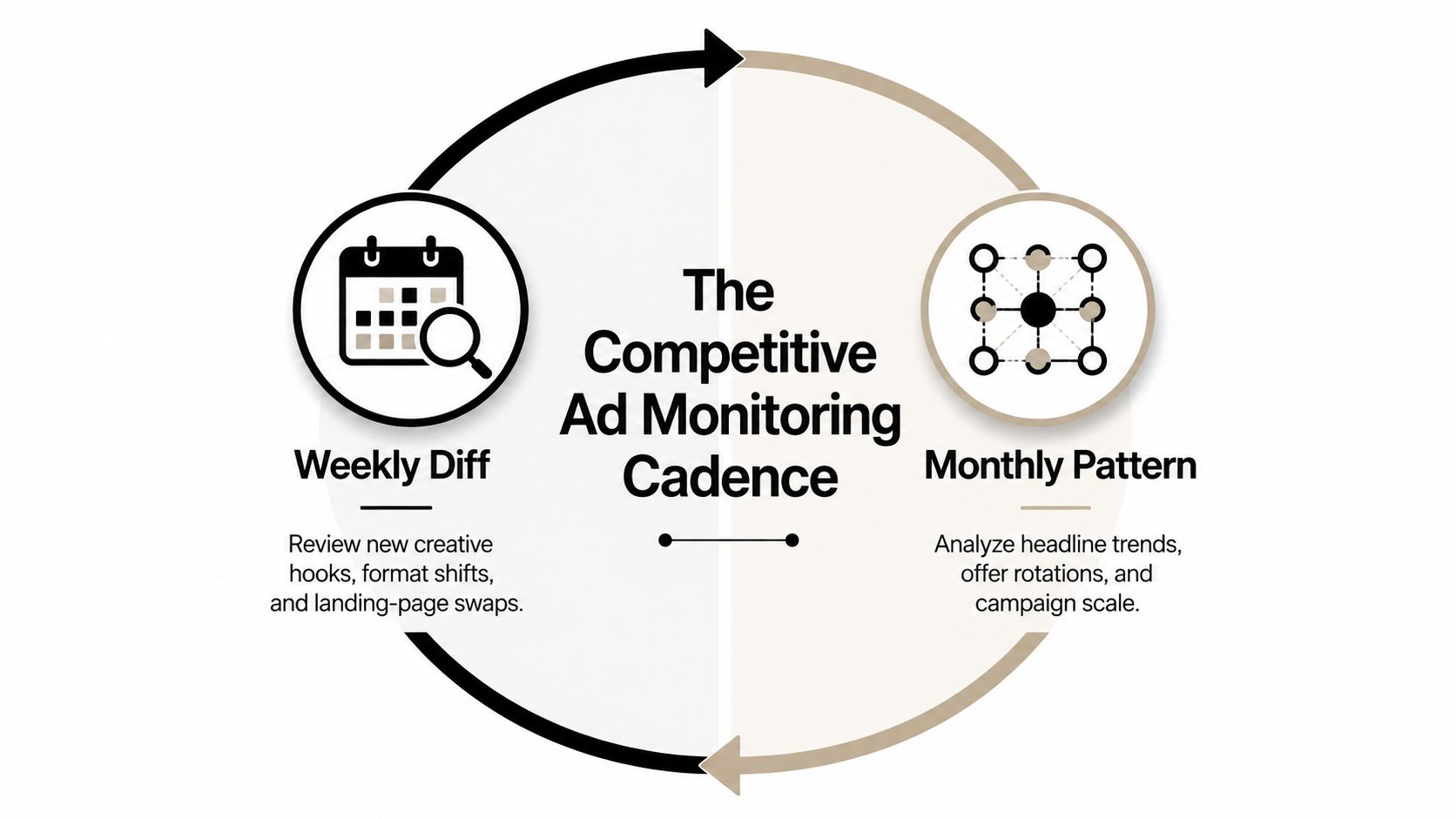
Operating Rhythm That Sticks
The minimum viable record per ad is straightforward. Track platform, core hook, CTA, longevity in days, and landing-page URL. That schema gives the analyst enough structure to compare what changed, when it changed, and whether the change survived long enough to matter.
A weekly diff should focus on new creative hooks, format shifts, and landing-page swaps. Routing those diffs into Slack or email means reviewers only see material changes, which reduces alert fatigue.
A monthly pass should look for recurring patterns across headlines, offers, and calls to action. It should also compare how long different families of ads lasted, because duration often reveals which message themes got budget and which ones were dropped.
Review rule: if a new ad doesn't alter the hook, format, or destination, it usually belongs in the archive.
Landing-page congruency deserves separate attention because it tests whether the offer still holds after the click.
Surviving Ads and Abandoned Clusters Beat Raw Creative Volume
The surviving ad matters more than the abundant ad. Volume can mean experimentation, but survival remains the stronger proxy for what a competitor thinks deserves continued spend.
What Dead Ads Reveal
The advantage comes from studying abandoned clusters, not just the ads that remain live. Dead clusters show which angles were tried, which ones failed fast, and which ones faded slowly before disappearing.
A fast failure is easy to tag. The ad appears, runs briefly, then vanishes without a visible family of follow-up variants. A slow fade is subtler, because the idea hangs around, loses momentum, and then gets retired after several iterations. Those outcomes tell different stories about budget tolerance and internal conviction.
Cross-brand repetition is the strongest clue of all. When multiple brands test a similar angle, keep some version of it live, or resurrect the same promise later, the analyst is probably looking at a concept that matters commercially.
Analyst rule: skip angles that multiple brands have already killed, and elevate the ones that survive in different forms across competitors.
For AI search, the surviving pattern has a stronger chance of being re-encountered, re-associated, and cited consistently.
A Case Study in How Ad Persistence Moved Our LLM Citation Share
A mid-market B2B SaaS competitor kept one offer framing live for 14 months, and that persistence changed our content engineering. The team mapped the ad's longevity, identified the entity anchors repeated across the landing page, and aligned the client's GEO assets to the same language family.
The result was a measurable shift in citation share inside ChatGPT and Perplexity within a 3 to 6 week window. Persistent ad language gave the analyst a durable message model, and the content team used that model to build more consistent entity references across the client's owned surfaces.
A durable paid message often becomes an easy clue for a retrieval system to recognize, especially when the surrounding content repeats the same entity logic.
The lesson is simple. Competitive ad monitoring matters most when it changes the inputs to GEO work.
The Enterprise-Ready Competitive Ad Monitoring Checklist
An enterprise program should pass governance, capture, alerting, and measurement checks before it touches a live workflow. That standard keeps the process defensible for procurement, security, and analytics.
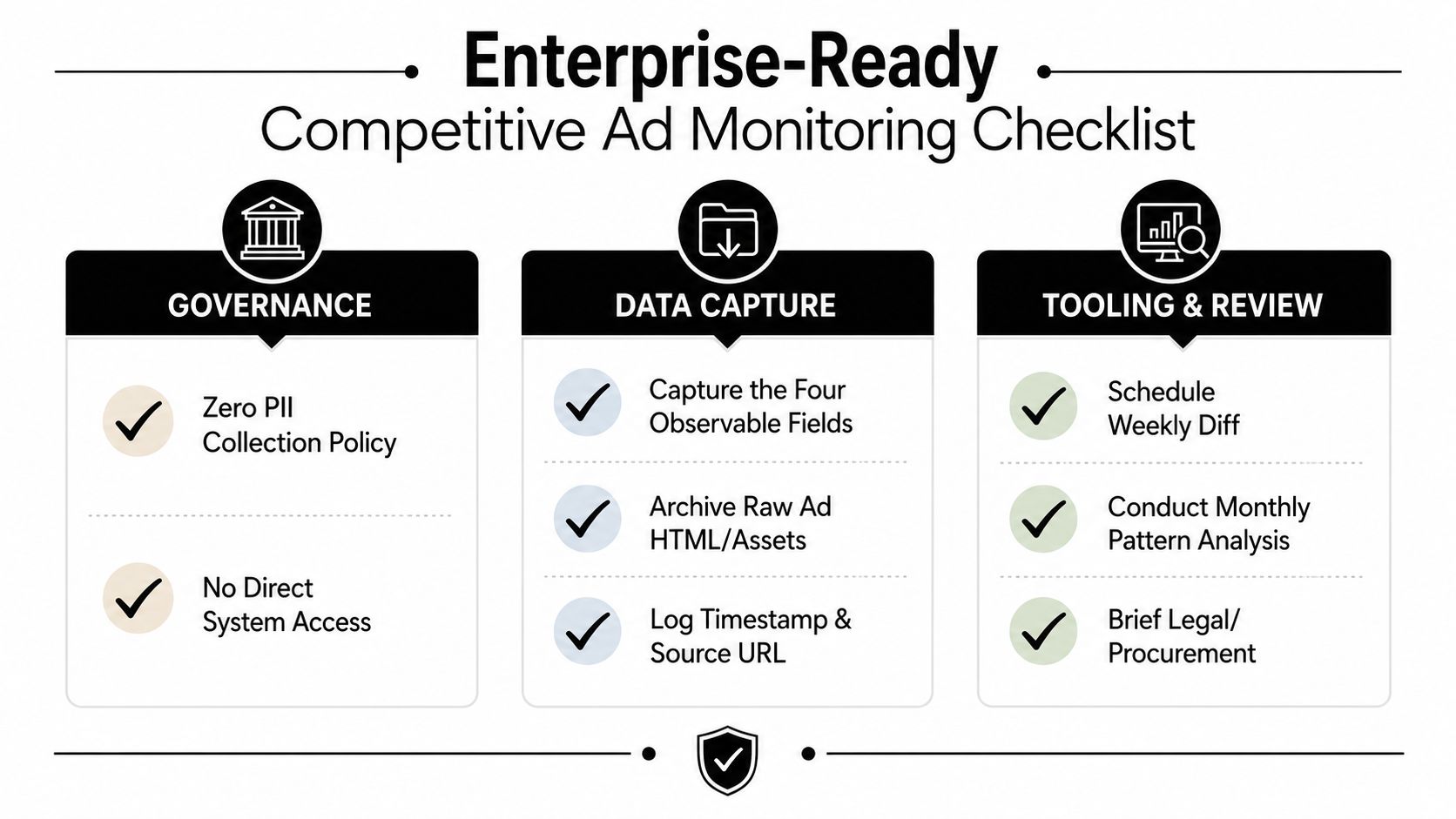
Governance
-
Zero PII collection policy is documented and enforced.
-
No direct system access is required to monitor public ad surfaces.
-
Legal and procurement have reviewed the sources before rollout.
Data Capture
-
The four observable fields are captured for every monitored ad.
-
Raw HTML or assets are archived when public access allows it.
-
Timestamp and source URL are logged for every snapshot.
Tooling and Review
-
Weekly diffs are scheduled and routed to named reviewers.
-
Monthly pattern analysis is used for cross-competitor comparison.
-
Every alert maps back to a GEO decision, not a vanity report.
The operational test is simple. A monitored ad should tie back to a downstream decision.
One option in that stack is Algomizer's AI visibility platform, which measures how brands appear in AI-generated answers with headless-browser tracking and third-party verification. That kind of measurement belongs after the monitoring model is built.
Algomizer helps brands track and engineer visibility inside AI-generated answers across ChatGPT, Claude, Gemini, and Perplexity. For teams that want competitive ad signals translated into AI-search outcomes, Algomizer offers complimentary visibility assessment, prompt discovery, source mapping, and independently verifiable measurement that ties visibility work back to business impact.
Updated November 2026 to keep this guidance aligned with how ChatGPT, Claude, Gemini, and Perplexity currently surface brands.
Written by
Myriam Aousaji
PR & Social Media Manager, Algomizer
Myriam leads PR, brand storytelling, and communications at Algomizer, the AI search optimization firm cited by Andreessen Horowitz and Entrepreneur. She runs the earned-media programs that put client brands onto the third-party pages AI engines cite, and works directly with the Algomizer Research team to translate its citation data into guidance for marketers. Her work spans the GCC, European, and North American markets, combining creative brand positioning with data-driven insight to build authority in the fast-moving AI search landscape.