
LLM SEO for Business: A 2026 Playbook
LLM SEO playbook for 2026: audit AI visibility, engineer citable passages, instrument retrieval, and measure share of answer across ChatGPT and Claude.
Article by
AI Search & GEO Research Team
The in-house team behind Algomizer's original studies on how AI engines retrieve, cite, and recommend brands.
Human-written and fact-checked by Algomizer Research. Claims are checked against the primary data and third-party sources linked throughout the page. Last verified November 23, 2026.
Algomizer expertise published & cited by
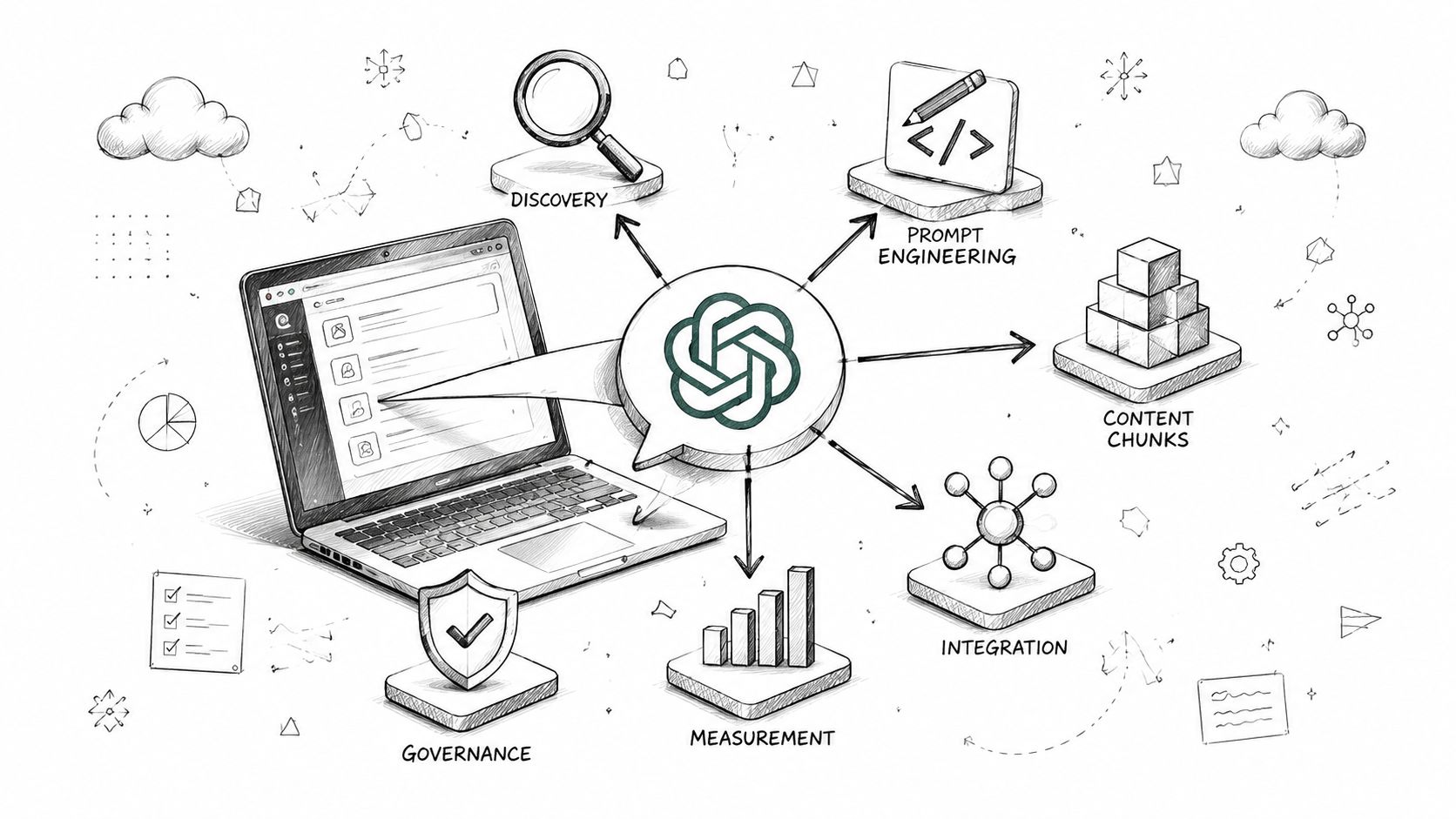
When it comes to SEO for business with LLMs, we can back up our claims with data. In our foundational GEO study for instance, we found that the best GEO tactics increased visibility by up to 40% on word count position and up to 28% on subjective impression. Keyword stuffing on the other hand decreased visibility by 9% in our controlled benchmark. All data was collected in a separate benchmark for keyword penalty in GEO as well as in a controlled GEO benchmark.
So while marketing leaders can design a page to be crawlable, well-written and commercial, that does not guarantee inclusion in the answer-layer citation. There are a number of reasons for this including the relevant passage not having been retrieved from the page; the chunks on the page having insufficient context; the reranker having chosen a clearer competitor answer; or the synthesis stage having failed to include a brand’s answers. We use ChatGPT, Perplexity, Claude and Gemini to identify the specific failure points and then to instrument around them.
What Is LLM SEO?
LLM SEO refers to the process of optimizing a website’s content, architecture and external authority in order to get large language models to extract and cite individual passages from the optimized content within generated answers. This form of work sits on top of, and to some degree is the same as AEO and GEO work. Measuring share of answer plus average citation frequency across ChatGPT, Perplexity, Claude and Gemini is key to evaluating the effectiveness of a working LLM SEO program. Such a program consists of four main activities: prompt discovery, passage-level content optimization, building retrieval instrumentation and tracking cross-platform citations.
Key Takeaways
- Viewing AI visibility as a retrieval pipeline with 5 points of failure helps to realize the full potential of AI.
- Audit retrieval on each platform with a fixed prompt set and re-run it over time to store all prompts, dates, models, answers and referred URLs.
- Engineer each passage to self-contain an entity, a claim, evidence for the claim and a boundary for the passage.
- Add quotes, named statistics, etc. to the passages you want the models to re-use.
- Attribute the results to the corresponding pipeline stage, and then credit the content or engineering team as appropriate.
- Run the above cycle on a fixed cadence, since updates to models change the behavior of retrieval on seemingly unchanged web pages.
Why ChatGPT Optimization Is a Pipeline Problem
Optimizing ChatGPT for business is engineering a pipeline. Most of the work happens before we actually render out a page to show information. The passages that are in the page have to survive query interpretation, retrieval, chunking, reranking, and finally answer synthesis. So even if a page contains the right information to support a citation, that doesn’t mean the AI will find it.
First, the query is fed into the query understanding module, which extracts intent, entities, relations, and constraints from it. Then, the retrieval module searches for corresponding documents or passages in the index and uses semantic as well as lexical signals. The quality of the candidate set at this stage of the process is crucial for the evidence to be processed in the subsequent stages successfully.
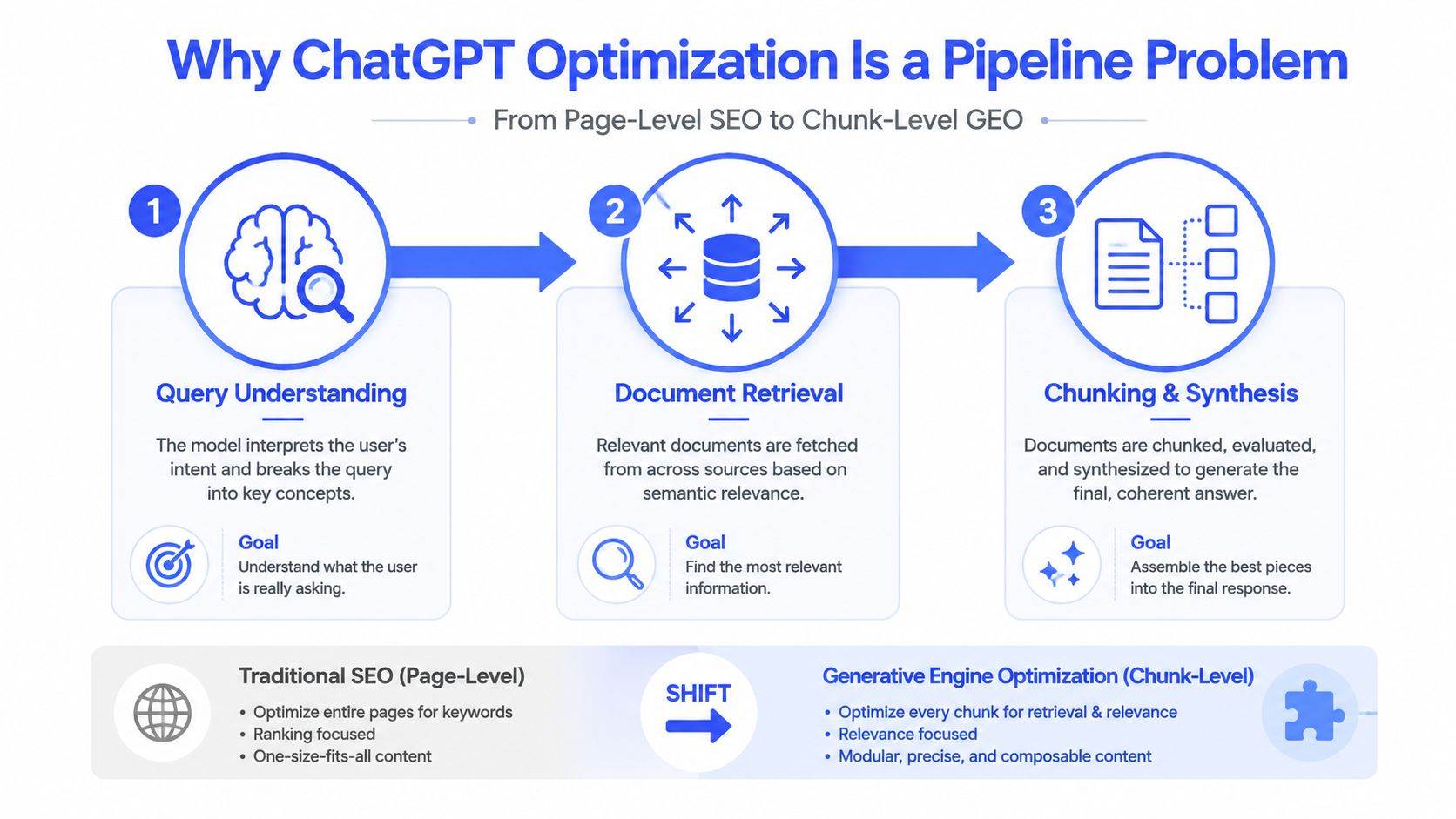
Where visibility is earned or lost
The term Chunking describes the units of information that can be retrieved by a retrieval system. Long pages are split up into sections, into individual paragraphs or even into overlapping windows of text, and all of these chunks are then represented for similarity matching. A passage that just says “the platform reduces operational risk” without mentioning the platform, the audience, the mechanism or any evidence to support the statement has very weak retrieval fidelity even when the surrounding page contains the necessary information.
The pipeline creates distinct optimization surfaces:
- Query understanding: explicit entity language, product categories, use cases, comparison language of buyer queries.
- Document retrieval: how well can we crawl, index and find authoritative mentions of a document within structured HTML and semantically dense passages.
- Chunking: Include sufficient local context to make sense as a standalone document fragment.
- Embedding similarity: The same meaning must also be found within the selected passage.
- Reranking: Relevance, Authority, Clarity, Freshness, Source Fit. Easy to evaluate evidence.
- Synthesis: Make claims traceable so the model can preserve the source and attach citations during answer construction.
The location of citations within a chunk matters. A claim and its supporting evidence that are not located together can pass retrieval but fail reranking because the evidence read by retrieval appears ambiguous. Thus, it is also important to keep entity, claim, mechanism and citation together when optimizing a query for a particular retrieval task.
We use the content structure (including the schema), internal links and external authorities in the input layer. The updates to the model, index coverage, source-selection heuristics and citation behaviors are all system variables that we can audit. To this end, we distinguish from mere copywriting and inauditable ‘black boxes’ by having the 2024 GEO benchmark test evidence-rich passages against metadata-rich pages that have been optimized for the metadata alone.
Discovery and Audit of AI Visibility
The repeated execution of the same queries on a fixed set of prompts (e.g. commercial, comparative, branded, category-specific) across the different AI systems (ChatGPT, Perplexity, Claude, Gemini) establishes the AI visibility. Although the same query is executed on different systems, it may appear in different sources and even contain different citations. Therefore, being visible in one system does not automatically imply visibility in the other systems.
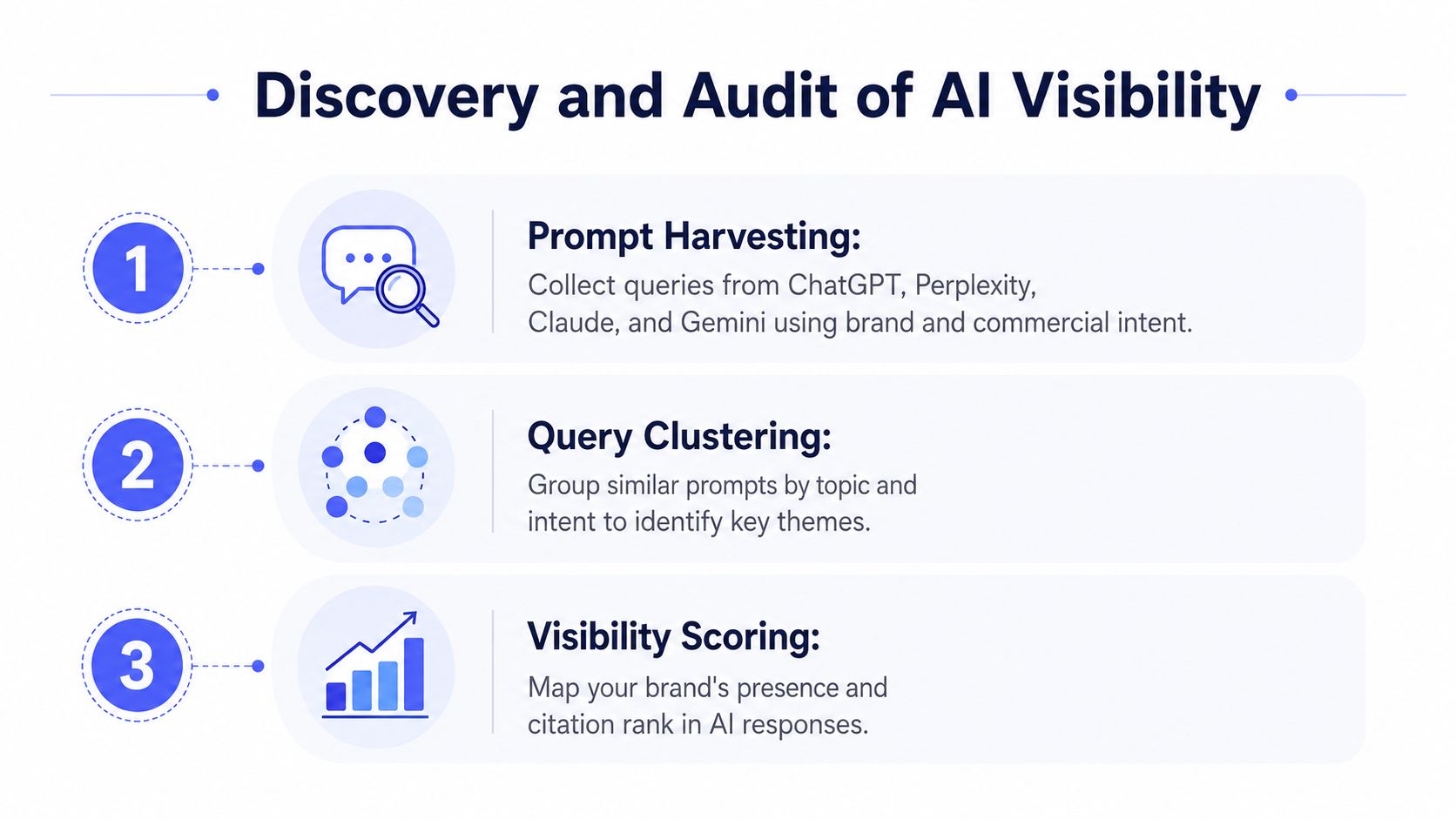
A repeatable audit routine
Step 1: Build the query inventory. This starts with a list of questions that are being asked in sales conversations with customers, buyer comparisons with competitors, customers’ statements describing problems they are facing, and even brand-specific prompts asking about the company and its competitors.
Second, capture a baseline. Store the following for the full answer found: cited domains, brand names and competitors found, position in answer, and recommended action. Store the prompt, date, site, model, etc. when available, as well as URLs for citations found. This turns a static screenshot into a reproducible observation.
Map gaps in your query inventory across topics and user intent by comparing the brand’s answer share to that of its competitors for citation gaps (where competitors continually provide evidence for a topic where the brand has no relevant evidence) and retrieval gaps (where the brand has no sources with clear, self-contained answers).
Fourth, Score the opportunities. Rank the inquiries based on their commercial value, the frequency of their appearance in competitor’s sourcing, the weakness of the current brand-related evidence, and the feasibility of publishing / earning authority on the part of the brand. Use this list to continuously update and complete the prompt libraries and corresponding Evidence Clusters.
Track repeated observations of an AI’s output to confirm one favorable answer is not a one-time occurrence. Measure whether sources have been continuously cited, if corresponding sources have been reused in subsequent answers, if a brand has been mentioned, and where the answer appeared within a search result list. A formal process to track AI visibility over time using the same prompt and evaluation criteria to perform repeated audits is called AI visibility tracking.
A short audit video can standardize capture and review:
An AI-assisted draft is often ‘cleaned’ by the publishing team with simple unmark removes chatgpt watermark handles of chatgpt before an audit record is even captured. The measurement rule remains the same: save original prompt, response, used citations and the surrounding evaluation context. A useful audit record captures information on changed retrieval conditions, the cited source, and whether the findings persist across platforms.
Prompt Engineering for the Input Layer
Prompt engineering determines what input the model receives. Answer optimization determines what output the model produces. Together, prompt engineering and answer optimization create an untestable black box, where all changes to input (instructions, evidence, formatting) have unknown effects on retrieval and citation.
A stable prompt library needs to be managed with version control and clear evaluation criteria. This means that you maintain a number of separate templates for e.g. research extraction, citation for seeding, full answer, competitor answers, and quality check. Each template should specify a number of criteria: audience, query intent, allowed sources, output format, citation rules, failure cases etc.
Evidence Clusters anchor reusable prompts
An Evidence Cluster consists of source-grounded snippets, organized around an entity, claim, use case, or comparison. A research prompt can refer to an Evidence Cluster, ask for differences between supported and unsupporting claims, and then, in the drafting process, supply the approved evidence. The Evidence Cluster functions as a controlled input asset with a clear scope.
Few-shot examples should be framed to reveal answer structure rather than serve as additional evidence. Likewise, separate levels of instruction for the system as a whole, specific tasks, and individual pieces of evidence. At each of these levels, separate constraints regarding safety/privacy/sources, query/output, and attribution to supplied (versus unsupported) material.
So, a simple rule to follow: version your prompt, your evidence, your model, your retrieval criteria and your evaluation results.
A versioned template makes citation behavior testable:
v1.2, research answer
Question: [query]
Use the supplied evidence to answer directly.
List relevant sources.
v1.3, research answer
Question: [query]
Use only the supplied Evidence Cluster.
Attribute each factual claim to a named source.
If the evidence does not support a claim, write “insufficient evidence.”
Return: answer, cited sources, unsupported-claim check.
The second template introduces a source boundary, attribution requirement and abstain condition for the reviewer. This enables the reviewer to trace back a citation to the evidence that was provided for it and to mark any claim that was generated by the model’s uncontrolled recall.
Changes to the base-model, embedding-model or even the structure of the source page prompt for a single page all cause prompt drift. Run a fixed test set off of each updated material and compare the number of inclusions, entities detected, and task completeness to the prior version which can then be rolled back as needed.
| Dimension | Input Layer | Answer Layer |
|---|---|---|
| Primary target | Prompts, instructions, source sets, retrieval settings | Claims, citations, recommendations, brand mentions |
| Main failure | Ambiguous intent, weak evidence, instruction conflict | Omission, hallucination, inaccurate attribution |
| Control method | Version control, templates, Evidence Clusters | Response capture, human review, citation audits |
| Success signal | Reproducible retrieval and task compliance | Durable share of answer and source visibility |
Repeated keywords in the prompt do not establish boundaries for the needed evidence or improve attribution. The input layer must make the conditions for the retrieval explicit, restrict the search space for the allowed evidence and save the used configuration for each test. The quality of the citation as a pipeline result is then saved with the used configuration.
Content and Citation Engineering at the Chunk Level
All retrieval candidates on a cornerstone page. Visibility of a passage is preserved when the entity, question, claim and evidence are all close to the beginning of the passage and the model does not have to search deep into the rest of the passage to recreate its overall meaning.
An Answer Capsule is a self-contained chunk of text of roughly 80-140 words that includes an entity, a claim, and supporting evidence near the beginning of the passage. There is no current benchmark that establishes an optimal length for a passage as a retrieval component; however, the Passage should still be readable when retrieved by a retrieval system with only nearby surrounding words.
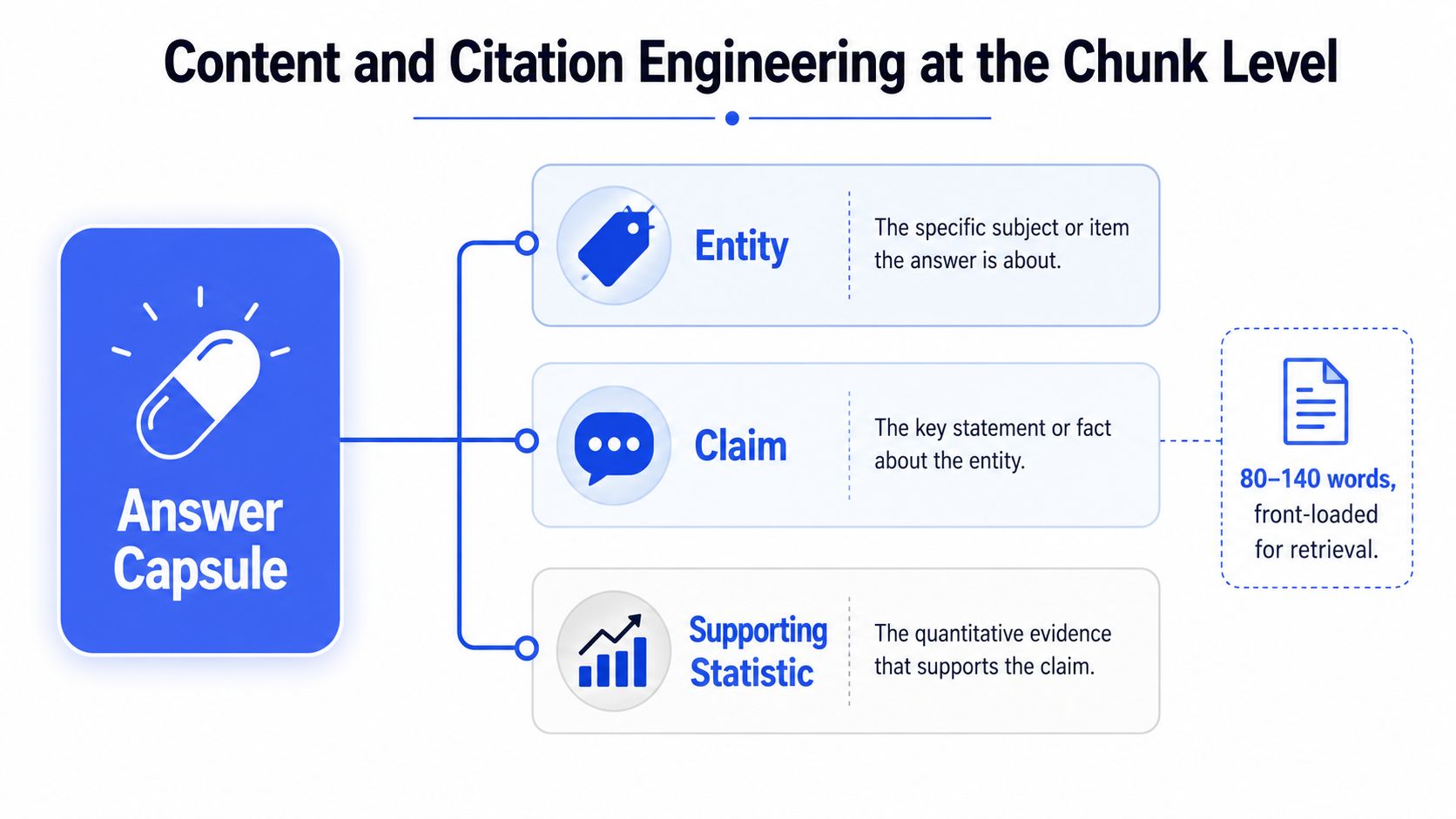
Semantic density as a retrieval signal
Semantic Density is the measure of how much content actually contains identifiable information (entities, relationships, evidence, specific terms and concepts). High-density writing identifies product, category, target audience, method, limitation and source. Generic positioning language adds words but does not add significant embedding model or reranker retrieval signal.
A reliable capsule follows this order:
- Entity: The entity name (company name, product name, category name, standard name) is stated at the very beginning of the capsule.
- Claim: This describes what the entity does for whom and under what circumstances.
- Evidences: Numbers, Quotes, Findings & Source-Based Comparisons.
- Boundary: What the claim does not say.
An example of a capsule for a fictional product is shown below. This would be input to retrieval systems such asiera and schema-based synthesis, allowing the systems to understand an entity, claim, evidence boundary and use case within a single short passage of text. “AtlasDesk is help-desk software for regional retailers. It aggregates email and chat and puts them into a single ticket queue where topics are assigned to team members to handle on a first-in first-out basis. There is also a history of previous responses and a flag on cases that are still open after a certain period of time. The team at one of the retailers’ internal offices of research reported that after configuring things for their team members, that team members were able to assign cases to each other much faster than before. Note that AtlasDesk does not handle refunds, safety issues or account issues and that such issues would need to be handled by human escalation. AtlasDesk is very suitable for support teams who need to see all cases and who can make use of rule-based routing of cases to team members.”
Using the right markup to accurately represent the structure of the content you wrote to improve understanding of entities such as Organization, Author, FAQPage, Product and Dataset, even if your evidence is weak.
Off-site authority for evidence also provides additional support for a brand mentioned on their own web pages. This could include original research, proprietary data, commentary from experts, and mentions in the content of other third-party authoritative publications.
Source diversity matters because citation resilience depends on more than one discoverable page.
Refreshes of stable URLs, update of dated claims, fix of broken citations as well as preservation of all internal links between capsules that are related to each other. In addition, chunk boundaries of a stable piece of content engineering need to be checked after substantial edits of generic content (even a minor re-arrangement of same can split up an entity from its corresponding evidence).
So in summary, engineering small amounts of stable and durable content is way more valuable than simply pumping out more generic content that will likely break in short order. And when it does break, can you still answer the question and properly attribute the original source of the extracted information?
Technical Integration and Measurement Infrastructure
This work can be turned into an observable system for a business by connecting up the internal retrieval work to use OpenAI APIs or Assistants-style applications, and to use stores like pgvector, Pinecone or Weaviate for the vector store, and choose chunking by the shape of the content. This can be semantic chunking (i.e. follow the topic boundaries of the content), recursive chunking (i.e. follow the structural separators in the content), or late chunking (i.e. chunk broadly throughout the document and then represent that as a passage).
Each component in the retrieval stack fails in different ways and therefore should be implemented as a separate, independent component.
| Component | Options | Best For | Cost Tier | Latency |
|---|---|---|---|---|
| Vector store | pgvector, Pinecone, Weaviate | Embedding search and metadata filtering | Varies by deployment | Varies by index and query load |
| Chunking | Semantic, recursive, late-chunking | Matching passage boundaries to content structure | Low to moderate engineering effort | Usually preprocessing-heavy |
| Reranking | Cohere, cross-encoder, LLM-as-judge | Refining candidate relevance | Varies by provider and compute | Adds a second scoring stage |
| Measurement | Headless browser, response archive, dashboard | Cross-platform answer observation | Moderate implementation effort | Depends on run scheduling |
Instrument the full retrieval path
Production audit: capture prompt, retrieved candidates (where available), reranker scores, final answer, citations, confidence, model context. Headless-browser testing of UI (across ChatGPT, Perplexity, Claude, Gemini): catch issues that API-testing would miss (e.g. how citations are displayed), also catches interface-specific answer changes.
Show the percentage of answers that were provided, the velocity of citations appearing across a set of monitored prompts, the entity coverage in an answer that associates a brand with relevant products, categories and use cases, and competitor inclusion and retrieval relevance.
Custom GPTs and Actions can extend the controlled brand surface of your public site to all areas of your organization. Ensure that access to proof in the public environment is separately controlled from access to your proprietary corpora. PII should not be included in prompts, in embeddings, in logs or in evaluations that are exported. (Governance can allow for the handling of PII in model training corpora as needed.)
I would like to have embedding monitoring set up as a separate alert. Just because the source pages haven’t changed doesn’t mean the nearest neighbor has changed for the model. The prompt libraries for all the tests should be stored in repository version control and for each test run there should be a snapshot of the evaluation and possibly even alerts for regression in relevance, citation inclusion and entity coverage.
While running the model-facing application through the security testing part of the deployment checklist, specialized pentest LLM tests for prompt-injection attacks, boundary-testing of the retrieval functionality, as well as exposure of the application under test can be performed. A dedicated AI search tracking tool is required for cross-platform visibility measurement of monitored prompts and their corresponding citations.
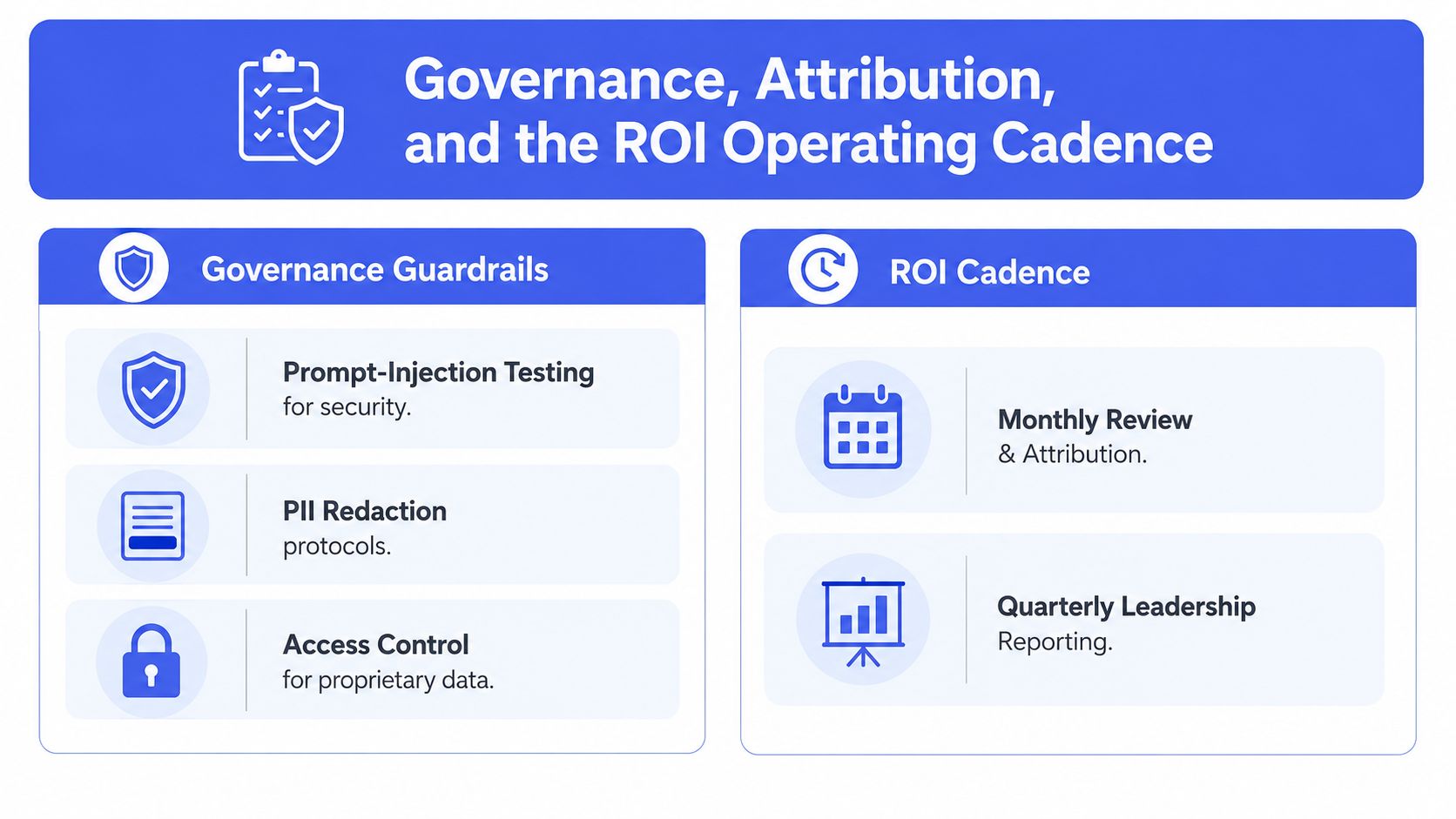
Governance, Attribution, and the ROI Operating Cadence
Visibility through AI is not a one-off campaign, but rather an on-going marketing activity, governed by an appropriate Operating Model including security, approved data sources, clear responsibilities and appropriate attribution to Answer Behavior and corresponding Pipeline Activity.
Prompt-injection tests should test a model’s ability to honor retrieval constraints and follow priorities in natural language prompts. PII redaction should occur prior to injection into input features that are stored as vectors in logs and other dashboards. Access to proprietary corpora should be controlled by role and use case, and content approval should identify who is able to publish evidence to influence model answers and who will review such published claims thereafter.
Attribute the answer to the stage that earned it
Attribution should separate four stages:
- The relevant source for the query has entered the candidate set for retrieval.
- Reranker score: The source outranked competing passages.
- The selected source appeared in the final answer of the citation injection test.
- Commercial outcome: Citation precedes Assisted Conversion, Influenced Pipeline or Branded Search action.
This enables us to distinguish between credit going to your content team and to your retrieval team for a result influenced by a new retrieval index, as well as between credit going to your external authority and to your technical team for evidence provided by the external authority to support a conclusion reached by your system. The longitudinal audits that are so lacking (a gap noted in 2026 GEO survey of 45 studies from 2026) would be facilitated by such a structure to determine among several causes causal absorption, to track system drift, to uncover multi-actor competition, and to translate visibility into value.
Assign specific questions to specific periods of time. Weekly audits of retrieval can surface broken sources as well as relevance regressions. Share of answer on competitors, as well as citation rank of entities covered, and the assisted-conversion actions taken as a result, should be reviewed monthly. Quarterly calibration tests of fixed sets of prompts on ChatGPT, Gemini, and Claude will highlight shifts in model performance. Annual strategy reviews will surface issues with target entities, as well as commercial priorities, sources, and governance ‘risk’.
A 2025 Semrush study of AI search traffic published in 2025 estimated that, on average, a visitor arriving from an AI search engine is 4.4 times as valuable as an organic search visitor (based on conversion rate). Therefore, it is rational for senior managers to treat visibility from an AI search engine as a revenue channel. Local assisted-conversion and pipeline reporting would then have to validate this relationship on the individual company’s data.
A one-page operating memo for your AI search channel would outline the monitored prompts, share of answer, cited sources, retrieval regressions, and governance incidents among other metrics. The memo should be clear to distinguish movement on the metrics from causation. One citation does not prove that a channel created revenue for you.
LLM SEO FAQ
How is LLM SEO different from traditional SEO?
Traditional SEO is ranked by position in a list of links. LLM SEO is ranked by passage coverage and number of citations in generated answers. As a result, the primary unit of work becomes a passage and the primary success metric becomes the share of answers generated by each assistant.
Is LLM SEO the same as AEO and GEO?
The three terms are another way of describing the same thing. Answer Engine Optimization looks at the answer, Generative Engine Optimization at the Generative System behind it and LLM SEO at the model performing the retrieval. You can run all three as one workstream with one prompt and one measurement dashboard.
How do you measure LLM SEO results?
Monitor share of answers, citation frequency, citation velocity, entity coverage and competitor inclusion on a fixed set of prompts. Run that same set of prompts on a scheduled basis on different platforms. Then correlate with assisted conversions and influenced pipeline in analytics.
How long does LLM SEO take to show results?
Crawl frequency, index refresh frequency and external brand authority all play a part in establishing timely metrics. Change appears on the prompt set across successive monthly reviews. Subsequent model updates will affect retrieval on previously un-tested pages.
Does schema markup help LLM SEO?
Adding schema to your markup really matters when your visible content matches. Entity relationships between Organization, Author, FAQPage, Product and Dataset can be made explicit for both retrieval and synthesis systems with corresponding markup. Weak evidence on a page is still weak after you add markup to it.
What kind of content gets cited most by AI assistants?
All of these types of self-contained passages name an entity, assert a claim, support that claim with evidence from a single source and bound that claim in some way. The tactics that have the strongest tested effect on citation likelihood are quotation, statistics, and sources cited.
Why Algomizer Is the Right Partner for LLM SEO
Algomizer is a managed service provider. It runs LLM SEO as an engineering program and measures every step of the retrieval pipeline described above. So, unlike most other services and products to aid with LLM SEO for marketing teams, there is nothing for them to license, log into or operate, four things that are important for them.
We track the output of every step in the pipeline for the same set of citations.
Cross-platform measurement: citations are tracked on a fixed prompt set for various models, such as ChatGPT, Claude, Gemini, and Perplexity to separate durable share of answer from favorable single response.
Outcomes-based pricing: we price the engagement based on the outcomes that your marketing efforts are trying to achieve (citation growth).
First-party evidence: We track prompt-level data across all our client accounts. That original data is used for the content engineering part of the work that we do for our clients.
About Algomizer
Algomizer is a Generative Engine Optimization service provider, that helps brands earn citations in answers generated by AI in ChatGPT, Claude, Gemini, Perplexity and Google AI Mode. We manage all engagements with a team of strategists, analysts and content engineers.
We help brands building and monitoring such a value stream to connect AI discovery with downstream commercial activities using the right GA4 attribution models. As a managed service, Algomizer’s team of strategists, analysts and content engineers implements AI visibility assessment, prompt discovery, content engineering, media placement and technical implementation for ChatGPT, Claude, Gemini and Perplexity. Visit Algomizer to get your brand assessed for current citations, identify retrieval gaps and set up and track an optimization cadence for AI-generated answers.
Refreshed for November 2026 with the most recent guidance on how AI search engines retrieve and cite sources.
Written by
Algomizer Research
AI Search & GEO Research Team
The Algomizer Research team studies how large language models retrieve, cite, and recommend brands, and turns those findings into the strategies we run for clients. Its work has been cited by Andreessen Horowitz in its Generative Engine Optimization research and by Entrepreneur, and it publishes the original datasets behind every study so journalists and analysts can verify the numbers.