
What Is Media Placement and Why It Matters in 2026
How paid, earned, owned, PR, and programmatic placements shape visibility, trust, and AI-era discovery, plus a decision framework for placements that compound.
Article by
PR & Social Media Manager, Algomizer
Leads brand communications and AI-search PR programs across the GCC, Europe, and North America.
Human-written and fact-checked by Myriam Aousaji. Claims are checked against the primary data and third-party sources linked throughout the page. Last verified November 23, 2026.
Algomizer expertise published & cited by
Media placement is the deliberate positioning of a brand inside third-party media environments. In 2026, it matters because placements shape how brands are surfaced, remembered, and cited in AI-assisted discovery.
Media placement has been a growth discipline for decades. A landmark University of Colorado report found the product placement market reached $3.46 billion in 2004, grew 30.5% that year, and compounded at 16.3% from 1999 to 2004. The broader market expanded at a 10.5% compound annual rate since 1974, which helps explain why placement strategy still matters - University of Colorado report.
Why Media Placement Is the Hidden Lever Behind Visibility
Media placement connects paid distribution, PR credibility, and AI visibility. Many definitions reduce it to buying slots, but placement also shapes whether a brand appears in a sponsored story, an earned article, a search result, or a model-generated answer.
Why the definition changed
Older definitions focused on immediate delivery. Today, placement choices also influence framing, reuse across channels, and whether exposure leaves a retrieval trace that search systems and models may surface later. That is why the category has lasted, and why the University of Colorado report still matters as evidence of long-term structural demand.
Practical rule: A strong placement creates exposure, authority transfer, and retrieval value.
The key distinction is between placements that generate attention once and placements that continue creating value after the first view. That is why placement strategy now sits beside PR distribution and media buying in planning. For teams mapping these mechanics to product distribution, the SaaS content distribution guide is a useful reference. The same logic also applies to AI answer visibility through AI product placement strategy.
| Channel Type | Primary Objective | Typical Buyer |
|---|---|---|
| Paid media placement | Reach and conversion | Media buyer |
| Earned media placement | Third-party credibility | PR team |
| Owned media placement | Controlled brand messaging | Content team |
| Programmatic media placement | Algorithmic efficiency | Performance marketer |
| PR placement | Outlet coverage and authority | Communications lead |
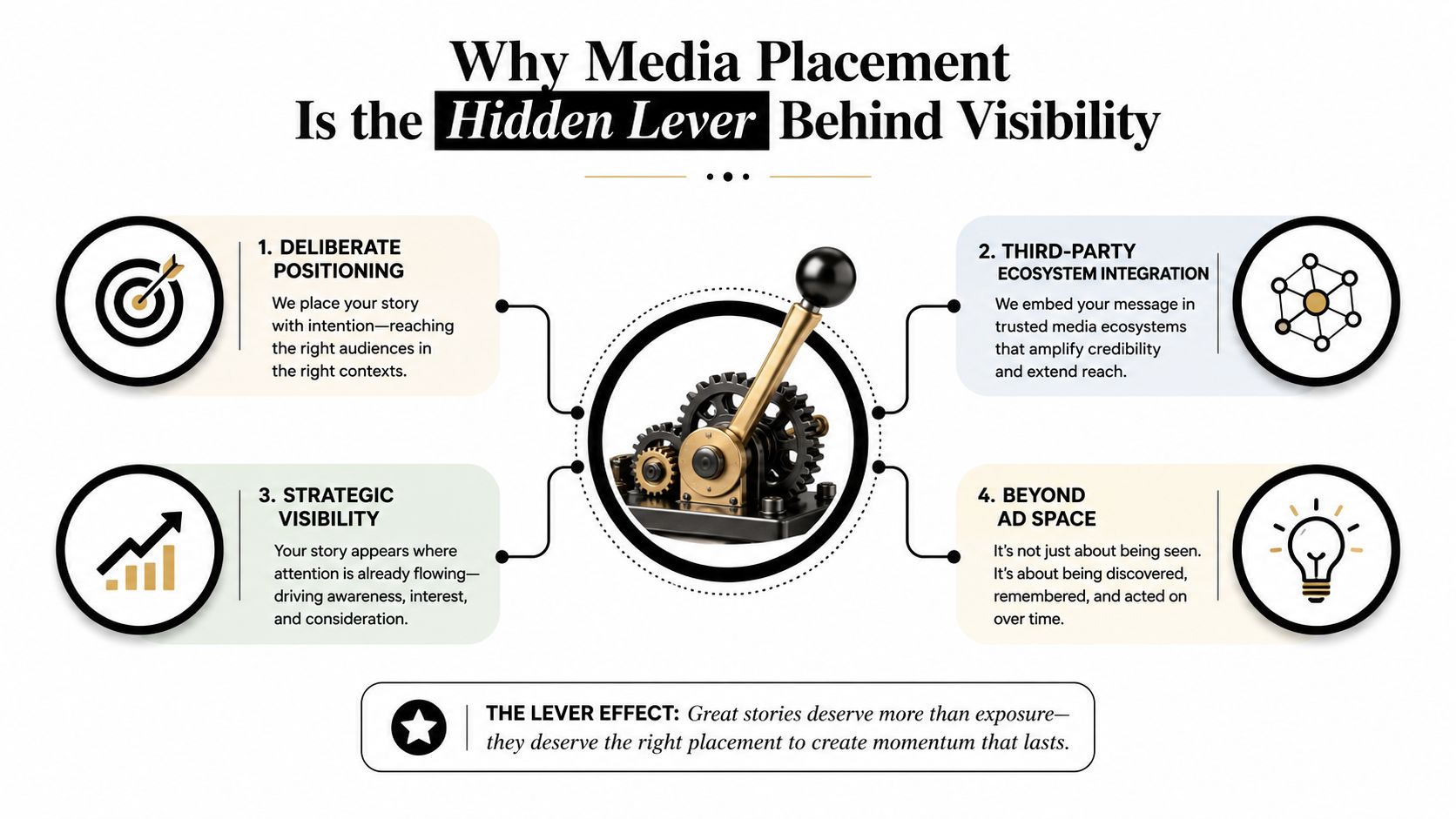
Media placement determines where trust is built, where attention concentrates, and where systems associate a brand with a topic.
The Five Types of Media Placement and How They Differ
The same term means different things depending on who is using it. A media buyer, PR lead, and content strategist may all say “media placement,” but they control different variables and measure different outcomes.
The taxonomy that keeps teams aligned
Paid placement is bought inventory. Earned placement is coverage won through third-party interest. Owned placement is distribution on brand-controlled assets. Programmatic placement is algorithmic buying at scale. PR placement is successful coverage in a specific outlet. These distinctions change budget ownership, approval flow, and performance measurement. A useful companion to this taxonomy is the SaaS content distribution guide, which shows how goals shift by channel and buyer.
A PR placement is defined by the outlet, depth of coverage, and where the story appears. A programmatic placement depends on optimization logic and buying rules. A single KPI standard across all five types usually fails.
| Type | Objective | Cost Model | Control | Primary KPI |
|---|---|---|---|---|
| Paid | Reach and response | Fixed or auction-based | High | CTR, conversions |
| Earned | Credibility | No direct media cost | Low | Quality of coverage |
| Owned | Message control | Internal production cost | Full | Engagement, retention |
| Programmatic | Efficient scale | Auction-based | Medium | CPA, ROAS |
| PR | Third-party authority | Agency or labor cost | Limited | Tier of outlet, article depth |
Why the vocabulary matters operationally
The right label prevents bad buying. If a team wants guaranteed publication in a specific outlet, it has a placement problem rather than a pure PR problem. If the goal is broad awareness with controlled frequency, the team is working in paid or programmatic territory. This AI product placement guide is a useful reference because it separates promotional context from editorial context.
Quality beats count when the buying motion is reputational. One high-authority placement can matter more than a cluster of weak mentions, especially when outlet tier and article depth are strong.
Teams that classify placements correctly make better budget decisions and write better briefs.
How Media Placement Actually Reaches an Audience
A placement pays off only after the environment does part of the persuasion. A premium article page, search result, and social feed do not send the same signal, even when the message is identical. Context shapes whether content is seen, trusted, and acted on.
The audience flow behind the result
The route is simple. First, inventory is selected. Then the buyer secures it directly or through a platform. Then the content is served. Then the audience encounters it. Only after that does downstream action happen. That sequence is why media placement is a targeting and optimization problem, not just a creative one.
A placement in the wrong context can waste a strong message. The same asset shown in search, a niche publication, or a broad social placement will produce different levels of attention because each environment changes audience expectations and willingness to respond.
The broader market history supports that view. The market has been expanding at a 10.5% compound annual rate since 1974, which shows that branded content inside external media has been a durable commercial practice. University of Colorado report
Why context changes performance
Context shapes perception before the click. Timing affects whether a placement meets live demand or fades into the background. Audience fit determines whether it earns relevant attention or expensive noise. Teams that treat these variables as interchangeable often blame creative for a placement issue.
The operating logic is straightforward.
-
Select inventory against intent. Search, social, and premium article pages do not behave the same way.
-
Match timing to demand. Placement windows matter because attention shifts by moment and setting.
-
Measure the response path. Exposure is the first step, not the outcome.
-
Adjust by placement, not just by ad set. The environment often explains the result better than the creative.
A useful reference point for execution is press release optimization, because the content package often shapes how well a placement travels once distributed.
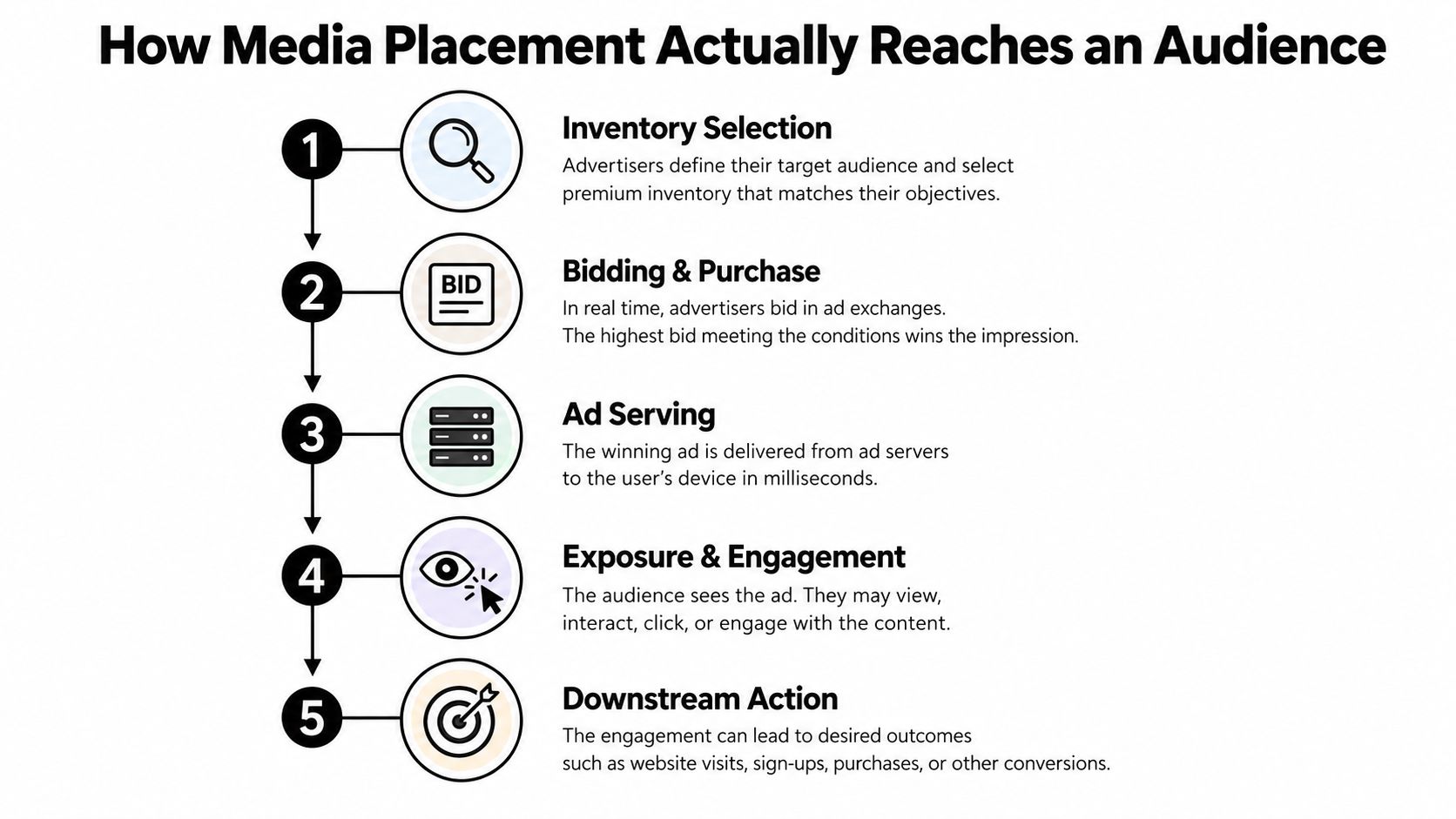
Teams that want to find Core Web Vitals metrics can use that layer to separate a placement issue from a page-speed issue, because both affect whether exposure turns into response.
The mechanism is the route a message takes. Once that route is visible, buying decisions and KPI choices become easier to defend.
Buying Models and KPIs That Drive Placement Performance
Buying model choice changes both efficiency and accountability. CPM, CPC, CPA, and real-time bidding each push teams toward a different optimization path, so the KPI has to match the model.
The numbers that force better decisions
A 2026 benchmark summary reported that Google Search Ads averaged 3.17% CTR, while Instagram Stories averaged 1.34% CTR. It also found Paid Search averaged 4.40% conversion rate, compared with 1.42% for retargeting display, and noted that CPA can vary by 30-50% depending on placement. The same dataset described Google Search as often delivering an 8x ROAS, while Meta placements ranged from 2.5x to 3.0x. Those gaps are large enough to change how a CMO allocates spend. 2026 benchmark summary
| Buying Model | Best Used For | Primary KPI | What Success Looks Like |
|---|---|---|---|
| CPM | Awareness | Reach, impressions | Broad exposure at controlled cost |
| CPC | Traffic | CTR | Efficient click generation |
| CPA | Response | Conversion rate | Lower cost per action |
| RTB | Scale and efficiency | ROAS, CPA | Auction-driven optimization |
| Hybrid placement buys | Mixed objectives | Multi-touch attribution | Balanced funnel performance |
Why the board cares about placement selection
The spread in outcomes means placement is a margin lever. A team can use the same creative budget and still get very different results if the environment is wrong. That is why reporting has to tie the buying model to the actual funnel stage.
A useful adjacent reference for performance measurement is Core Web Vitals metrics, because speed and usability on the landing page often determine whether placement-driven traffic converts or leaks away.
Strategic filter: If the goal is efficiency, compare placements by return, not average price alone. Low cost does not matter if the environment underperforms on conversion.
One internal benchmark for this category is the AI advertising agency model, since AI-first buying depends on placements tied to measurable outcomes rather than vanity exposure.
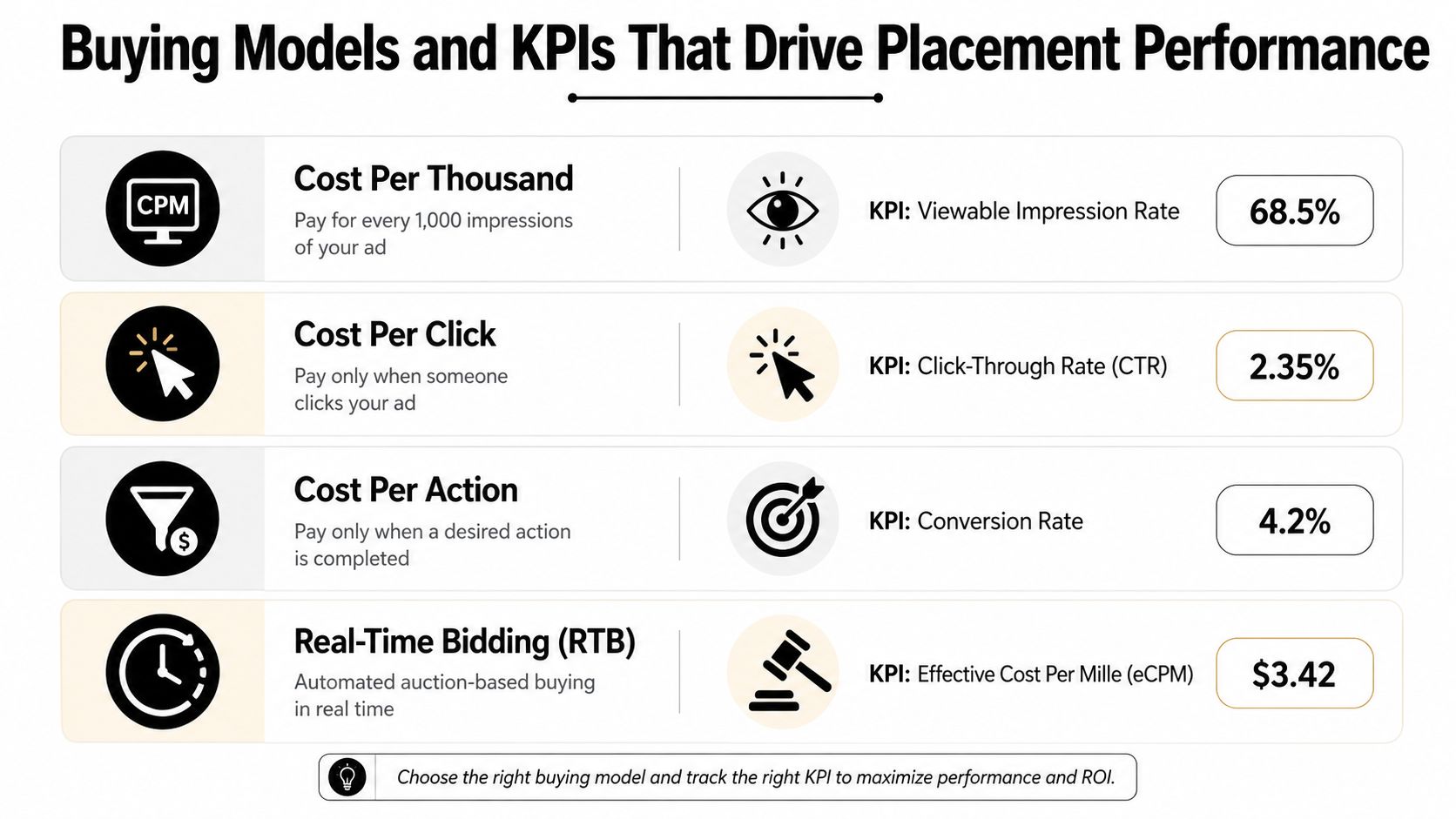
When the KPI matches the model, the buying decision becomes easier to explain and defend.
Media Placement as an AI Search and GEO Strategy
Media placement now helps shape what models remember, surface, and cite. That shifts the business case from distribution alone to discovery engineering.
Why the AI layer changes the playbook
A placement in a high-authority publication can keep producing search visibility, backlinks, and referral traffic long after publication. That matters more now because AI systems draw on a broad mix of external signals when generating answers and recommendations. Public guidance still does not provide quantified evidence on how those placements interact with generative search, and that gap matters for brands competing in ChatGPT, Claude, Gemini, and Perplexity. Baden Bower on media placement
A B2B SaaS company can use that dynamic strategically. A feature article in a relevant industry publication can become source material that both people and models encounter later. That gives the brand a more durable retrieval footprint.
How discovery turns into pipeline
The strongest placements do three things at once. They build third-party credibility, create a searchable public record, and reinforce brand associations that models can carry forward.
For teams already tracking AI search outcomes, zero-click answer tracking offers a better lens because it treats visibility as a retrieval problem, not just a visit problem. That matters when a user gets the answer without visiting the site, while the brand still appears in the citation trail.
Algomizer uses media placement as part of a broader GEO workflow by pairing placement selection with content engineering and visibility measurement. That matters because placement alone does not guarantee model recall, but placement combined with structure, authority, and topical fit improves the odds of being surfaced consistently.
AI-first rule: Judge a placement by whether it changes what the market and the models know about the brand, not only by whether it generated a spike in sessions.
The strategic conclusion is simple. Media placement has become a discovery asset, and brands that ignore its AI-search effect will understate its return.
Three Misconceptions That Distort Placement Strategy
Three bad assumptions still waste budget in enterprise placement programs. Each sounds reasonable until it shows up as poor measurement or weak discovery.
Misconception one, media placement equals advertising
That framing is too narrow. In PR, media placement means securing coverage in a third-party outlet. In advertising, it means selecting and purchasing inventory across channels. Those are different motions with different control surfaces, and teams should not blur them.
Misconception two, volume equals value
More placements do not automatically mean better placements. Outlet tier, article depth, and placement position matter, which is why count alone is a weak proxy for value. A program that treats every mention as equal will overpay for weak visibility and underinvest in authority.
Misconception three, placement stops mattering when publication goes live
That view ignores residual visibility. Effective placements can keep generating search visibility, backlinks, and referral traffic long after the publication date, which is why the afterlife of a placement matters as much as launch day. Brands that measure only the initial spike miss the compounding effect.
Corrective lens: If the report ends at publication, the measurement model is too small. The placement's downstream effect is part of the asset.
Each misconception creates a distinct failure mode. The first causes teams to buy the wrong motion. The second pushes them toward quantity over authority. The third causes them to miss AI-search upside and undercount long-tail discovery.
A Decision Framework for Choosing Placements That Compound
The best placement decision keeps paying back after the first impression. That requires four filters.
The four criteria that matter
Audience fit comes first because no placement works if the audience is wrong. Outlet authority matters because credibility transfers through the host environment. AI-citation potential matters because the placement has to survive beyond the initial click. Cost-to-efficiency ratio matters because budget still has to map to results.
| Criterion | Question to Ask | Weight |
|---|---|---|
| Audience fit | Does this outlet reach the exact buyer or researcher we want? | High |
| Outlet authority | Will this placement transfer trust? | High |
| AI-citation potential | Can this asset be reused, cited, or retrieved later? | High |
| Strategic compounding | Will the placement create future visibility, not just immediate exposure? | Medium |
What to do in the next 90 days
Build a placement scorecard before launch. Separate paid, earned, and programmatic buys by objective instead of lumping them into one report. Track downstream citations, branded searches, and referral quality alongside core delivery metrics. If the goal is AI visibility, prioritize environments likely to remain discoverable and referenceable.
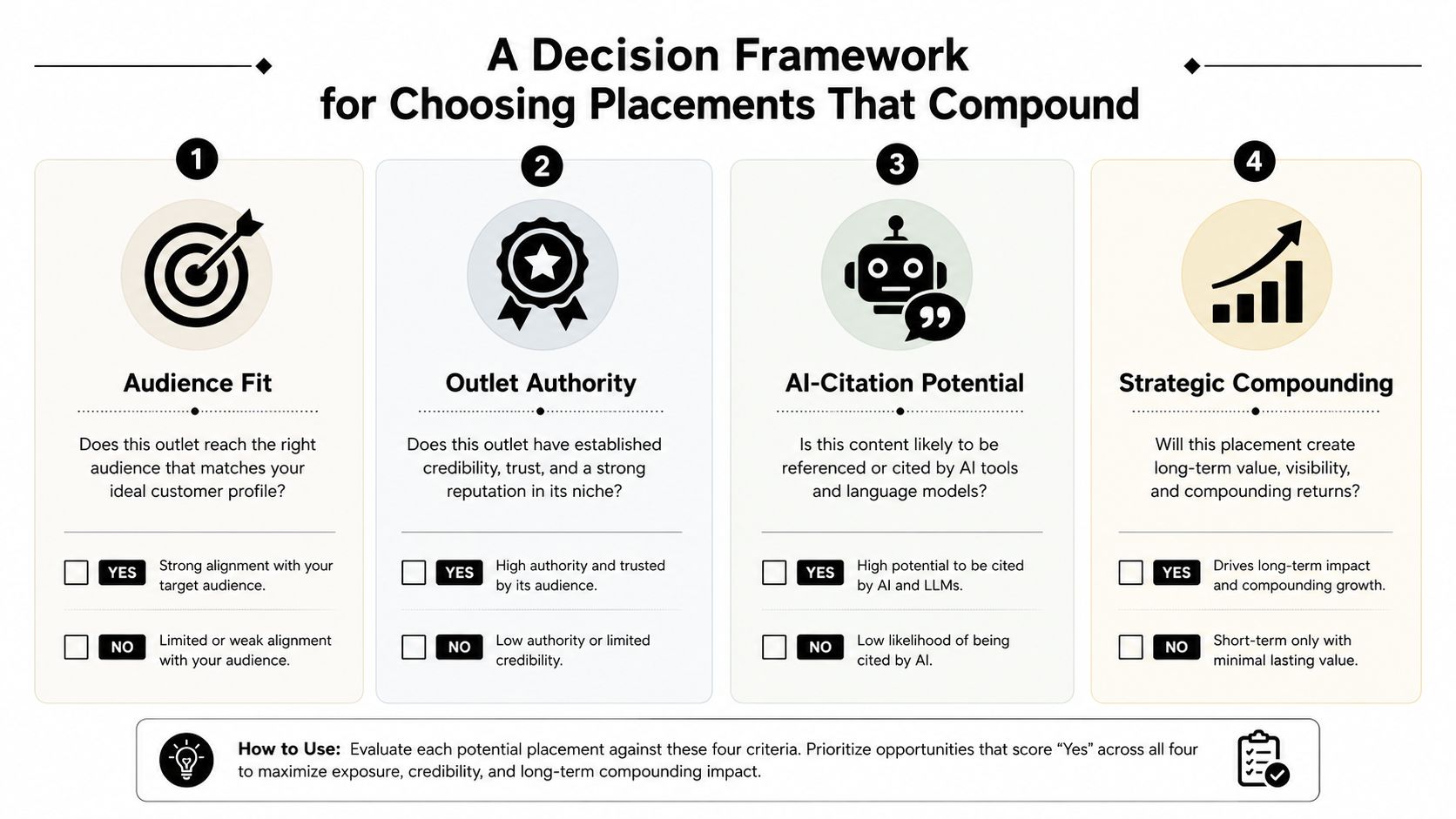
Algomizer offers managed AI-search visibility work that includes media placement as one part of the broader system, which makes it relevant for teams that need publication strategy tied to discovery outcomes. For brands that want a visibility assessment and a more disciplined placement plan, Algomizer is the right place to start.
Media placement is no longer a side category inside marketing. It is one of the few levers that can influence paid reach, third-party trust, and AI-era discoverability at the same time. Algomizer helps brands turn that influence into a measurable visibility program, so the next step is to get a complimentary assessment and map where placements can compound for your team.
Reviewed and updated in November 2026 to reflect the latest developments in AI search and generative engine optimization.
Written by
Myriam Aousaji
PR & Social Media Manager, Algomizer
Myriam leads PR, brand storytelling, and communications at Algomizer, the AI search optimization firm cited by Andreessen Horowitz and Entrepreneur. She runs the earned-media programs that put client brands onto the third-party pages AI engines cite, and works directly with the Algomizer Research team to translate its citation data into guidance for marketers. Her work spans the GCC, European, and North American markets, combining creative brand positioning with data-driven insight to build authority in the fast-moving AI search landscape.