
Top 10 AI Marketing Tools for Enterprise Growth
We compare 10 ai marketing tools for content, automation, AI visibility, analytics, and enterprise campaigns with practical pros, cons, and use cases.
Article by
AI Search & GEO Research Team
The in-house team behind Algomizer's original studies on how AI engines retrieve, cite, and recommend brands.
Human-written and fact-checked by Algomizer Research. Claims are checked against the primary data and third-party sources linked throughout the page. Last verified November 23, 2026.
Algomizer expertise published & cited by
While AI marketing tools are slowly but surely graduating from being the oddity that the marketing team experiments with to becoming part of the overall marketing operating system, adoption is moving in the right direction. As reported in the 10th edition HubSpot's State of AI reporting by Salesforce, 75% of marketing organizations are already using at least one form of AI. According to Compiled adoption data from surveys conducted in 2025, 66% of all marketers globally use AI in their daily work. And according to marketing leaders, 91% of the teams they work with already use AI. 79% of marketers using AI and automation in their work also state that these tools help them a great deal in terms of saving time on tasks that are menial and thus better to be spent on other, more strategic activities.
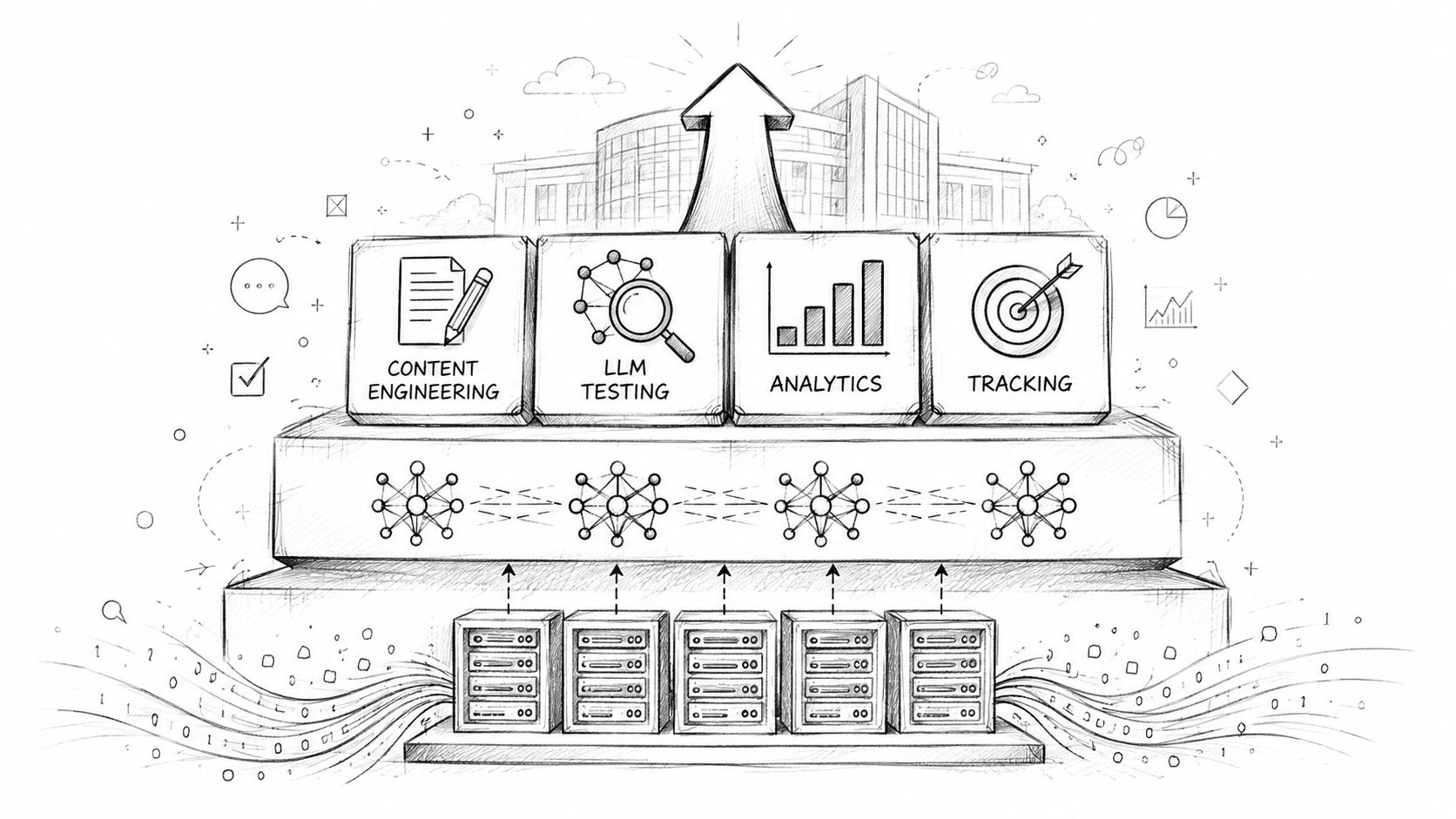
As the architecture of AI tools for marketing evolves from experiment to operating system, selecting tools is no longer about generating content but rather about layers of functionality, starting with input layers of published content, customer and press coverage, product information, past campaign information and more. The Answer layer comprises ChatGPT, Claude, Gemini, Perplexity, Copilot and Google AI Overviews to name a few and includes functionality to retrieve chunks, compare embeddings to rerank evidence and in the end synthesize answers. Most important for the Answer layer is high retrieval fidelity in order to get the right sources into the candidate set of possible answers. Chunk-level structure, Evidence Clusters and Semantic Density of sources on the other hand affect how a model interprets a given source. The goal of the business is share of answer including all possible citations and recommendations and even qualified traffic.
Below are 10 platforms that can be organized by the layer of control for the AI-answer (from highest visibility to enterprise-wide orchestration). Note that each tool was evaluated against execution, governance, measurement, integration, pricing complexity and operational ownership, the key decision-making factors after a pilot has ended. Note also that this architecture can be seen as part of a broader Generative Engine Optimization framework, that in addition to search visibility also considers retrieval and synthesis.
What Are AI Marketing Tools?
AI marketing tools are software platforms that use machine learning or generative models to automate parts of your marketing efforts. We categorize and review AI marketing tools based on the layer or layers that the tool controls. We use the advertised features of the tool as an additional way to sort the various marketing features that the tool provides to the enterprise buyer.
Two key layers are at play here: the input layer (e.g. your published web pages, customer records, articles, schema, etc.), the data that AI models draw upon, and the answer layer (e.g. ChatGPT, Claude, Gemini, Perplexity, Copilot, Google AI Overviews and more), where the data from the input layer gets reranked and generated into a response. A single tool can be limited to controlling one of these layers or even the connection between the two.
Key Takeaways
- Choose the right tools for the right layer, i.e. a tool to generate content is different from a tool to manage the customer lifecycle and a tool to track visibility.
- The input layer is governed by the execution platforms that you use for owned content, customer data and campaign execution.
- Measurement tools such as Semrush and Surfer look at the answer layer for your automation system (i.e. the prompts that are being sent, the number of citations in any given answer, etc. as well as how your competitors are answering similar questions).
- Content governance tools (Jasper, Copy.ai, Writer) help scale volume while keeping within approved language, product information and even regulated claims.
- Observation of the change in visibility and the intervention to improve the answer are two different activities.
- Total cost equals usage design. While seat price is a key factor, other factors like credit, tracked prompts, user activity and list size are also part of the invoice.
1. Algomizer
Algomizer is a Managed Service for Generative Engine Optimization and Answer Engine Optimization. Working at the answer layer, an Algomizer team implements end-to-end strategy, implementation, measurement and reporting. Clients don’t need to operate/ administer any software. Algomizer serves mid-market and enterprise brands, improving their citations, recommendations and qualified traffic to ChatGPT, Claude, Gemini, Perplexity, Copilot and Google AI Overviews. First, the team conducts buyer-question discovery in order to identify the necessary evidence that models need to retrieve and describe accurate brand information.
The retrieval to a brand’s evidence is the core of the work of Algomizer. A Retrieval-Augmented Generation (RAG) pipeline is used. High-recall embedding retrieval generates a large candidate set of potential documents. High-precision LlamaIndex's retrieval and reranking explanation is then used on this set to select the most accurate evidence for the retrieval task. The same principles are applied in the work of Algomizer for content engineering, digital PR, technical implementation, schema and question-and-answer libraries for brand evidence to improve the input to models before they select evidence from the answer layer for buyer questions.
There are also important constraints around chunk boundaries. For hierarchical retrieval, the parent chunks can be limited to 2048 tokens, with intermediate chunks set to 512 tokens, and then further down to individual sentences which are then reranked against the parent chunks using a Hierarchical Re-ranker Retriever paper. The evidence-cluster of Algomizer treats structure as an engineering constraint and thus is separate from copywriting preference. AI visibility methodology connects this structured copy to brand presence in buyer questions.
Why enterprise teams choose Algomizer
The Algomizer team acts as a cross-model, constantly calibrated, monitoring and measuring entity using headless browsers as part of the retained work. By using browser-based tracking the work avoids API limits and also the mistake of treating incomplete or even falsely generated API answers as results for your visibility checking. As an Enterprise solution no PII or access to your systems is required to check your reputation on the web.
It is paid based on the achieved thresholds of visibility or even additional revenue, unlike a retainer model. It’s also exclusive, as Algomizer only partners with one company per market.
Work with Algomizer as you would another department. Algomizer strategists, analysts and content engineers are staffed to operate as a managed visibility program as an extension of your own team.
Note that this model is a fully managed solution, and therefore may not be the best fit for companies looking for a low-touch content generator, or for companies that engage with multiple agencies (as with the HubSpot model for external evidence engineering). CMOs, SEO managers, SaaS and B2B companies, law firms, real estate companies and financial services companies are good candidates for this model, as they require assessment of citations, recommendations, brand accuracy and revenue.
Of course, for customers that are already using HubSpot for native AEO monitoring and work execution in the CRM, external evidence engineering is typically only required to monitor sources, entities or even reputation signals that are outside of the controlled content and customer-data environment of the HubSpot platform.
2. HubSpot Marketing Hub
The HubSpot Marketing Hub includes a CRM, marketing automation, content workflow management, and native AI. The AEO (Answer Extraction and Observability) tracking of prompts and brand share in AI engines is also included. Agent and custom-agent support for content and campaign-related tasks are available in higher-tier plans. The native Smart CRM connection also provides a shared customer data layer for segmentation and personalization.
The retrieval distinction is important for understanding where HubSpot fits into all of this. AEO observation of the answer layer for prompts and share of voice is supported by the CRM and campaign system’s control of the input layer via landing pages, email, audience, and workflow actions. A unified operating environment is key and HubSpot provides the key integration for content execution and customer data.
HubSpot State of AI report finds that 66% of marketers’ organizations are building their own internal marketing AI tools. So, yes, there is lots of adoption going on here. The real operational value of all this though will depend on how well these tools integrate into governed marketing processes and corresponding customer journey metrics.
Best enterprise use case
For mid-market to enterprise teams looking to deploy AEO observation through CRM-driven execution, HubSpot is a great choice. The platform allows prompt monitoring to be tied to content creation, segmentations, email automation and cross-channel reporting. predictable seat and limit based HubSpot models well to governance of large teams.
As for packaging, pricing seats + usage limits + add-ons (optional) + restrictions per tier is quite complex to model for total cost of ownership. Most of the advanced AI + customization HubSpot has is in the Pro and Enterprise tiers. One should model out users, active agents, automated volume, reporting needs etc. before picking seats to procure.
It’s also worth noting that there’s a big difference between HubSpot for AEO observation within a broader CRM-driven execution and a managed GEO partner for AEO where the partner builds external evidence and steers your brand description models. We would recommend reviewing the AEO versus GEO options before settling on a platform-only solution.
3. Salesforce Marketing Cloud
Salesforce Marketing Cloud controls the execution layer for email, mobile, journeys, advertising and customer data. Data Cloud unifies customer information across all channels. Einstein predicts customer behavior and adds scoring, send-time optimisation, content selection and generative campaign support to the marketing process. Agentforce and Copilot integration extends the predictive decisions within Salesforce.org products.
The core of predictive orchestration consists of the Einstein Engine which predicts the best time and content for marketing activities based on customer and campaign signals. Data Cloud is providing the identity, behavioral and consent layer for customer signals in order to segment and activate customers across channels and touchpoints via governed execution in Salesforce.
This architecture is where Salesforce is competing in enterprise AI marketing. We believe that Salesforce’s growth will depend on adoption of Data Cloud, because the unified customer records are key to Einstein’s ability to score, personalize and enable journey actions. We are tracking broader market growth in 2025 AI marketing statistics review. As organizations consolidate customer data in Salesforce, they require AI to make decisions within the CRM that they are already using. A standalone content tool is a different operating need.
Decision criteria for Salesforce buyers
Salesforce Marketing Cloud is well-suited for organizations that are already using Salesforce.com and can maintain adequate data quality. Predictive scoring and personalized marketing require consistent customer information, tracked activities, consent management and integrated customer data. Data Cloud enhances Salesforce Marketing Cloud. Additional clouds and modules to extend functionality increase complexity of implementation as well as related expenses.
Breadth of functionality for complex cross-channel customer journeys. Given that Salesforce offers customized pricing for each of its clouds and given that the sum of all individual clouds’ pricing may not reflect the total price of using all of them, procurement and architecture teams would be well-advised to request a description of desired architecture and usage in addition to a detailed review of the Einstein features of Sales Cloud, Marketing Cloud, etc. and how many administrators will be required to govern data volume, customer journeys, etc. to ensure that reliable decisions are produced by the system.
Autonomous campaign work requires another level of design consideration, as the work of an assistant to create an action is different from that of an agent executing a governed workflow with appropriate permissions and escalation. Our AI marketing agents framework provides a context for this design consideration.
In its trade-off Salesforce provides enterprises with extensive extensibility and powerful predictive functions only when they are matched by adequate data management, proper administration and appropriate governance. Broad functionality of this kind has little value if it is not consistently put into practice.
4. Adobe Marketo Engage
Marketo is used to manage the lifecycle of customers & leads in complex B2B and B2C customer journeys, for personalization and attribution on top of Adobe Experience Cloud. Adobe AI Assistant can also be used to support the user in his or her workflows. Adobe Express is used to generate content very quickly within the Adobe ecosystem.
The operational value of a tool like Marketo is to manage the individual steps of a coordinated journey. In terms of the specific steps in a program, a marketer can set up conditions for audiences, assign steps for content and next steps and then analyze the progression of people through a funnel using analytics and attribution. Additionally, Marketo allows for dynamic and governed personalization via modules for content that can change based on the context of audience or account.
Keep one claim per content block. So, in your Nurture emails and your Landing Pages, downstream systems and even AI crawlers will have complete and self-contained statements. Also, clear entities and consistent terminology when talking about your product, account and nurture content that is flowing through various connected workflows.
Where Marketo earns its place
Marketo Engage is well-suited for organizations with mature administrators who have an existing relationship with Adobe and require sophisticated journey capabilities. In addition to advanced analytics, Marketo supports attribution modeling, dynamic content and integration with the broader Experience Cloud.
Adobe uses a quote-based pricing strategy and as Marketo is a module of Adobe, advanced modules are cost-expensive and also require a more complex implementation. Named-user-licensing and the Adobe Admin Console for enterprise administration require careful access planning. In most cases, specialized administrators are required for setup of such campaign execution.
Content teams should treat AI assistance to produce content within the bounds of a governed process. As described in Content engineering for AI search, content structure has significant impact on human usability as well as on machine-based search and retrieval. That content can be distributed and personalized by Marketo. The monitoring and evidence functions must be separately designed and managed in order to ensure that appropriate evidence is actually retrieved by the AI engine and correctly cited by it.
Marketo provides deep capability for managing the answer layer for the lifecycle, and a separate capability for visibility would be needed to manage that.
5. Jasper
Jasper is a marketing governance tool. It is a Brand Voice and Style Guide enforcement system, built upon Knowledge Assets, Audiences and Marketing Agents. We position Jasper in the content-governance layer. The central enterprise question is: Can AI generate more assets while staying within approved language, approved product information and approved audience definitions.
Knowledge assets are used as a retrieval context. Brand rules restrict language, terminology and format. Agents apply the same rules to standard workflows in order to shorten the time from a given brief to a first draft. Subsequent human review then checks claims, evidence, required regulatory wording and most important the freshness of the sources used.
Jasper’s knowledge assets enable organizations to maintain on-brand and factually correct higher volume of production. A control system around approved knowledge assets for production requires up-to-date and authoritative knowledge source(s) and clear definition of approval for updates. Good Prompt engineering best practices can also help set up good instructions. But, in the end, prompts are not substitute for documented product information and for editorial review.
Governance and cost trade-offs
The marketing-specific design of Jasper’s usage design is more fitting for a brand-governance-oriented marketing tool than a general purpose chatbot. The upgrade path of Jasper supports the transition from single-user-drafting to enterprise processes. Business plans include no-code custom-agents.
Usage design contains the biggest cost surprise of all. A few of the agents and some of the workflow design features are only available on the Business tier (custom priced). Even some of the basic actions in agents cost credits. So it is not just seat price that one needs to compare.
Similarly, a company using Jasper for marketing-specific design needs to have a content governance owner. Brand Voice does not correct product facts that are incorrect, outdated policies or unsupported performance claims. This means someone needs to be responsible for updating source documents, setting prompt standards, reviewing output and archiving.
While the platform is well-suited for organizations with an established brand system, it doesn’t have independent tracking of citations and recommendations in AI answers. For such tracking, a separate measurement or even a layer of managed visibility would be required.
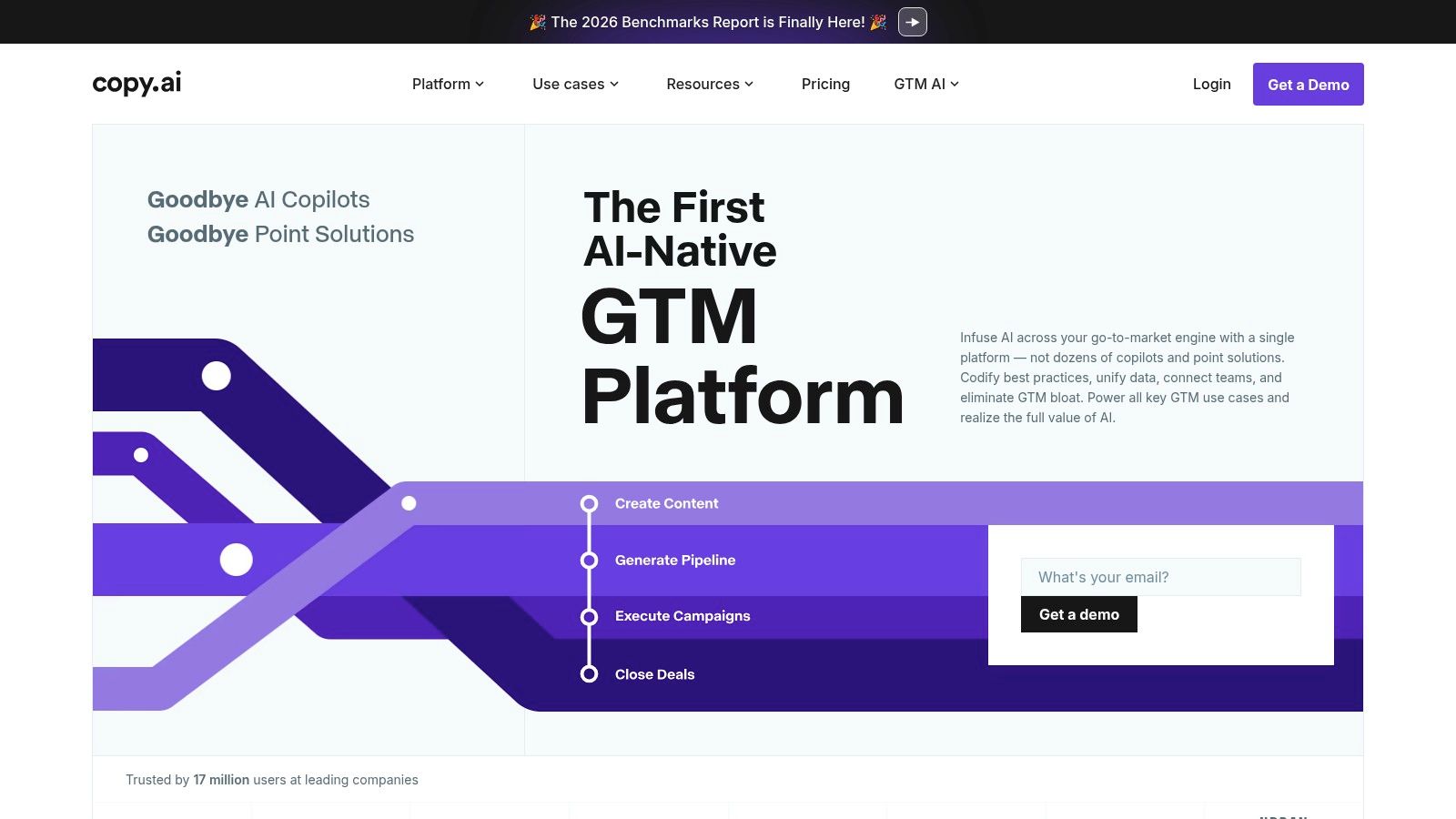
6. Copy.ai
Copy.ai is an enterprise orchestration layer that enables no-code Workflows, Actions, Tables, Brand Voice and multi-model access. We support OpenAI, Anthropic and Gemini models and enable our customers to create repeatable processes for their go-to-market activities instead of generating one-off copies of content.
A Workflow would sequence together research, generation, transformation and integration into a repeatable process. Actions would perform individual tasks, while Tables and other components on the intelligence layer would store structured information which subsequent steps could then reference. This enables marketing and sales teams to move from being assisted by chat, to fully automating GTM.
Therefore, the purchasing criteria for a content assistant are mostly based on the output quality for single tasks. Copy.ai on the other hand is evaluated based on the workflow quality, the consumed credits, the handling of exceptions, the correct grounding of data and the auditability of the process from input to generated output.
Practical enterprise applications
Copy.ai is best for teams that run research-to-draft workflows, repurpose campaigns, use Copy.ai for sales enablement, and generally run structured Go-to-Market (GTM) work. Multi-model access and Brand Voice are key differentiators here.
The cost to your organization for the research and work that your automations complete is determined by the number of Workflow credits your organization requires to complete the task, the complexity of the Workflow(s), the number of triggers, model calls, and rewrites in your process, and the size of your organization’s plan (e.g. smaller plans will not support larger organizations with broader adoption).
Note that as with any platform, the security and onboarding process of Copy.ai will also be a factor to consider. Enterprise onboarding is marketed by the company and a SOC 2-aligned security posture is described. Governance around inputs, permissions and connected systems will depend on how administrators set up the platform. It is also important to test out failure paths, e.g. when a Workflow is set up to write to a CRM or to distribute to external parties.
Copy.ai is best for organizations that want to run repeatable portions of their GTM work through automation without building individual custom automations. It is designed to be used in conjunction with answer-layer visibility to strategy, not to measure volume of generated copy as an increase in retrieval fidelity.
7. Writer
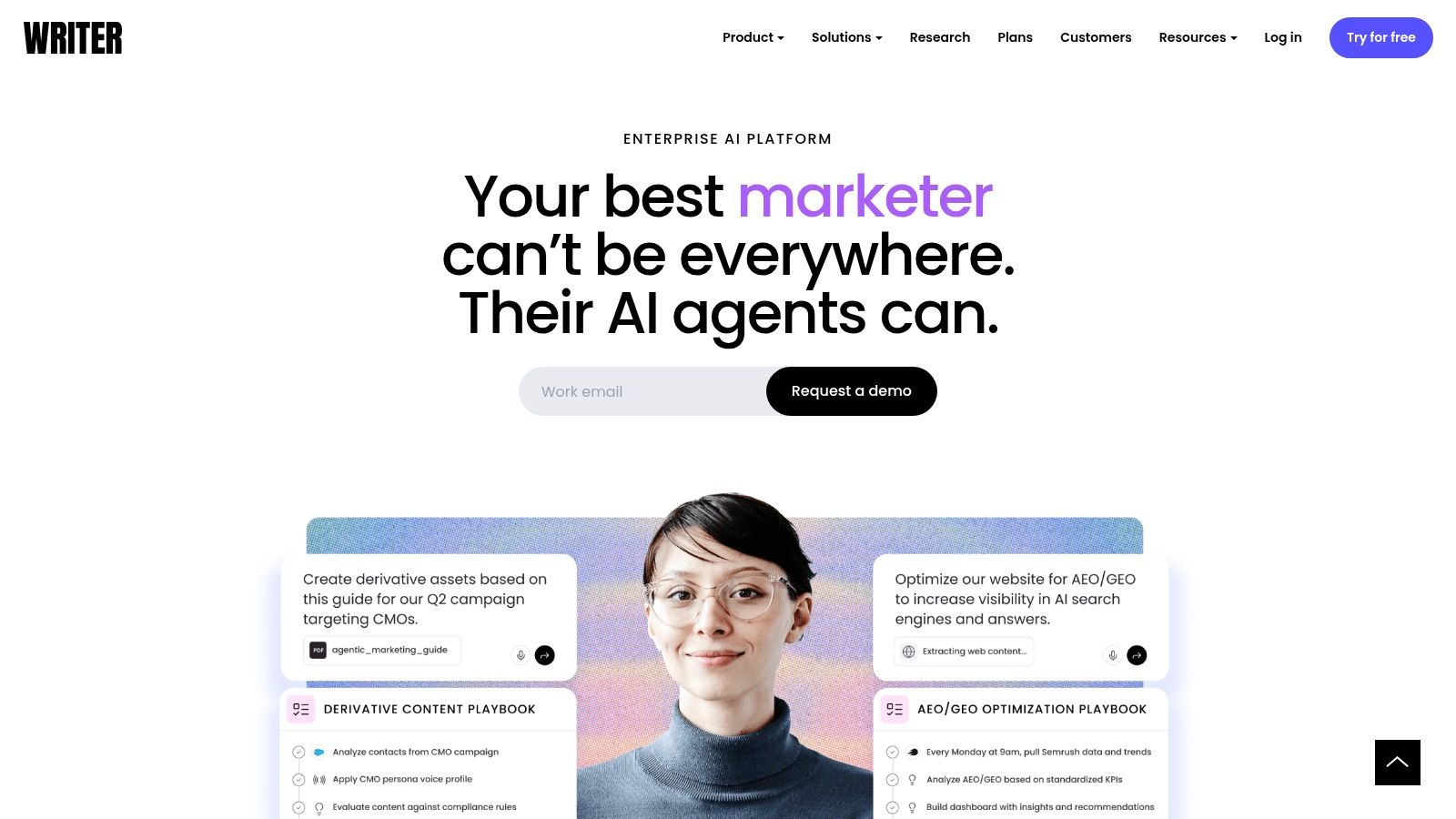
Writer is focused on enterprise governance, security, knowledge grounding, and agentic automation for marketing teams to produce auditable work in a controlled environment. WRITER Agent, Playbooks, Agent Builder, brand personality profiles, style guides, and knowledge graph are all examples of this.
Furthermore, Writer’s knowledge graph fundamentally changes how grounding for enterprise concepts, relationships, terminology and approved information is done within Writer. Then Playbooks specify steps for a process to be repeated, and the corresponding Governance settings limit who can do what and create a record of all actions performed.
These enterprise features do not in themselves guarantee to write compliant content, but they provide a framework within which legal, security and marketing teams can control who is able to invoke specific workflows, what data is input into the system and how generated output is reviewed.
When Writer is the better fit
Writer is ideal for companies that need to select and integrate different LLMs within their current enterprise stack. Data-control policies and auditability are essential for regulated teams, whereas marketing teams can apply brand voice and style guidelines to all of their campaigns.
Public pricing information is scarce and usually has to be requested via sales department. For the Starter-plan, for example, information about users and required Playbooks is provided in a written model that has to be requested. Based on this, necessary upgrades can be planned while adoption increases.
Most importantly, there needs to be an owner for Writer’s resources - a Security team to define boundaries around data, a Marketing operations team to maintain Playbooks, a Brand team to update style and personality in Style Profiles, and Legal to define a review process for claims that are considered to be regulated.
Writer's trade-off is control over enabling casual generation of individual pieces of copy. Writer is better suited for organizations requiring repeatable and defensible production of content within highly regulated workflows and processes.
8. Klaviyo
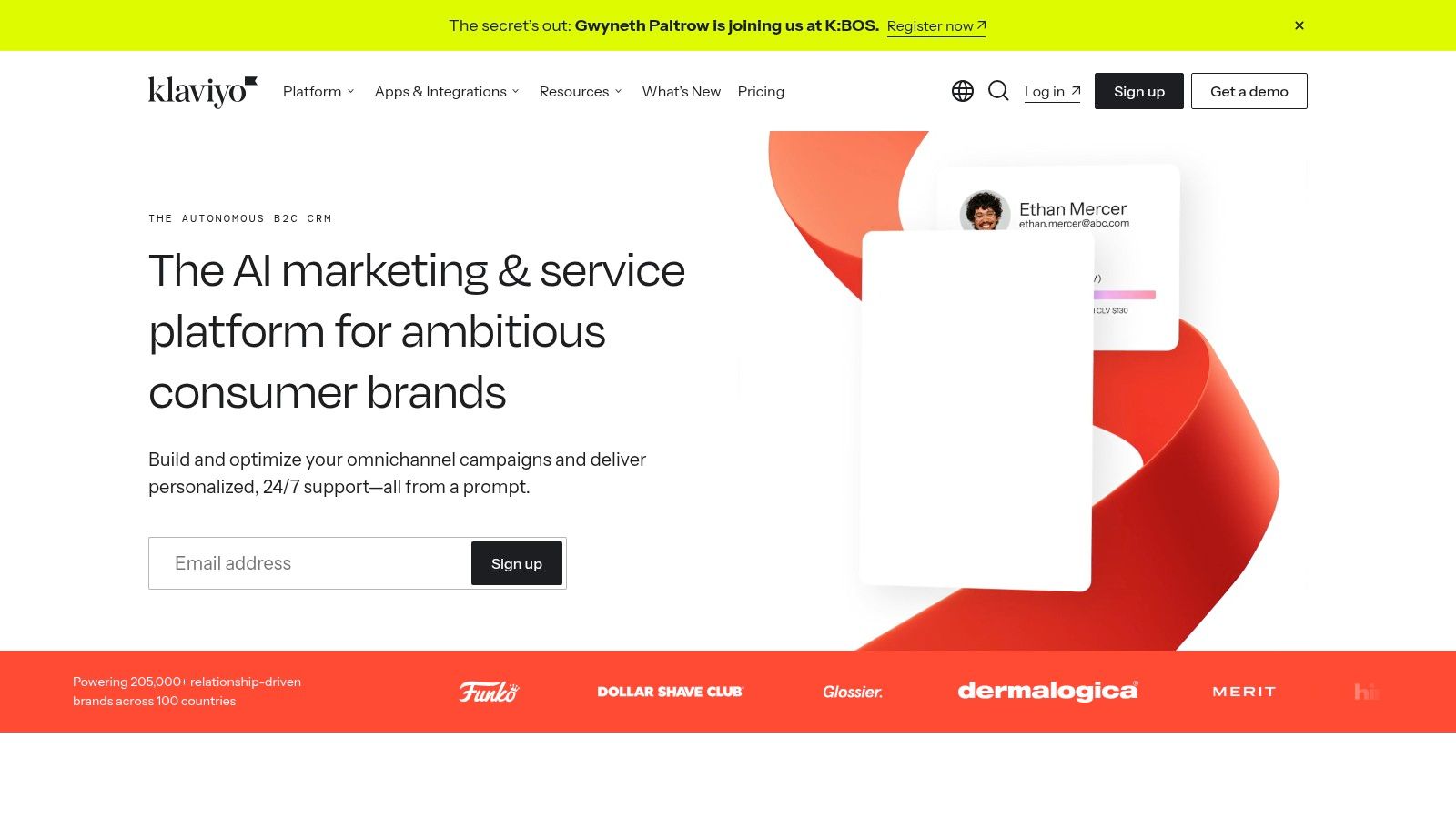
Klaviyo is used to control the B2C customer lifecycle in email, SMS, reviews, on-site interactions, predictive analytics, product recommendations and more. As a platform for commerce teams, it allows for tracking of customer behavior, campaign activation and revenue-driven reporting within a single operating environment.
Klaviyo’s predictive layer looks at a variety of behavioral and transactional signals in order to score and segment customers, predict timing and benchmarks, and provide product recommendations. Klaviyo’s Composer AI marketing agent is currently in public beta and can be used to create marketing campaigns. Marketing and Customer Agents are also available to extend the AI-assisted work already done in customer interactions. AI credits are another way to track usage on the platform, in addition to the list-size-based economics that already exist.
Best use case and constraint
We recommend Klaviyo for eCommerce & B2C companies running on top of Shopify & BigCommerce etc. Klaviyo’s strength lies in its deep execution on owned channels, connecting customer events to lifecycle actions. Use predictive insights to make better audience decisions, automatically generate campaign content and connect email & SMS to real business outcomes.
We are keeping an eye on the AI features of Klaviyo as they are part of the current development of the platform (public beta for Composer) and need to be monitored for the number of AI credits needed (e.g. for more agents in a flow or more campaigns). Also the costs for these features scale with the list size and the number of AI credits used.
Klaviyo is a very deep functionality within a brand’s own channels (email/SMS). Retrieving AI answers, placing citations, and brand recommendations in ChatGPT and other answer engines requires a different set of functionalities that are not part of Klaviyo.
In short, Klaviyo is a deep lifecycle specialist who lives in a larger tech stack. Use Klaviyo for the revenue-linked email and SMS work and then add an AI visibility measurement or a managed GEO for discovery inside generated answers for acquisition work.
9. Semrush One with AI Visibility
The major functions of Semrush One are to measure and to diagnose within the larger context of SEO and competitive intelligence. For answer-based prompt visibility tracking, we look at the coverage of search, content, advertising, social media, local SEO, AI-powered PR and overall AI-powered answer-based Visibility.
Semrush’s job here is to measure and diagnose. We track the prompts where your brand appears, see which of your competitors are getting mentioned, and even track changes in visibility for a set of questions over time. We use this information to highlight missing topics, poor positioning against competitors and even specific prompts where the sources you’ve used to create content about your brand are not appearing in answers.
The reports and results provided by Semrush need to be interpreted at the answer level. The GEO part of the Semrush infrastructure is a stochastic pipeline which first crawls and then retrieves information and finally applies this to create citations. Hence, the visibility information provided by Semrush only is directional. It tells you whether you can find a brand mentioned in answers to prompts, which sources where mentioned and how this changes for different questions. It does not explain individual retrievals, rerankings or syntheses in detail.
This is how we have structured the operating model around Semrush’ prompt visibility data. First, we establish a baseline, compare competitors to each other and monitor changes in answer presence over time. The content team then reviews the cited pages in detail, optimizes the evidence and structure of the content, tackles any technical barriers to access and then tests whether the changes have had the desired effect on the model’s output.
Best fit for integrated SEO teams
Semrush is designed for established SEO and content teams that are looking for a traditional search engine optimisation search intelligence tool, combined with AI-powered answer monitoring within a single platform. Its daily prompt tracking, reporting, export and API access enable regular analysis across brands, markets and client accounts.
Complex commercial models are created as organizations add domains, users and tracked prompts to their account. Therefore the selection of prompts to monitor will influence both cost and value. A focused set of monitored prompts would typically include commercial queries, the highest priority questions, competitor analysis and questions where the generated answer is used as part of the consideration process.
A platform of such breadth and depth naturally also demands a certain level of learning on the part of users and internal specialists, who need to understand the metrics of search, compare companies on the market, set up reports, and measure the content of AI answers. Evidence must be created and improved in terms of content, all necessary technical measures must be coordinated and verified.
I’d recommend you use Semrush as the measurement layer for your AI marketing stack. If you then add layers for content engineering, digital PR, technical SEO or even managed GEO execution, all of that changes the underlying evidence and Semrush can then provide the repeatable baseline to track how the answers become more visible and get better over time. Your teams then do the work to change the underlying evidence to get better answers, and Semrush provides the repeatable baseline to track that.
10. Surfer
Surfer is a AI-powered content optimization and AI Search Analytics tool. It contains a content brief, audit, on-page advice, AI-powered writing, daily tracking of input prompts, shareable dashboards, MCP and API functionality, and branded workspaces on higher tiers of pricing.
The execution loop of a content-marketing-oriented platform is very straightforward: First AI Search Analytics for a project determines the best prompts and their visibility. Then the corresponding content tools support the optimisation of existing pages, improve the structure and finally align on-page elements with the project’s search and AI-discovery objectives.
The workflow needs more than just keyword coverage because of the way chunking and dense retrieval research are implemented. Dense retrieval compares query embeddings with the indexed chunk embeddings of a corpus using cosine similarity. The quality of the query embedding and the boundaries of the indexed chunks greatly affect passage recall. Therefore, even though Surfer provides content guidance for structure and topical clarity, human review is needed to verify the factuality of the information, the sources used, brand claims, and the depth of evidence.
Pricing and operating limits
Surfer’s AI-powered visibility tracking for prompt-based AI analysis is offered via different pricing tiers with daily prompt limits, while unlimited tracking is offered on a custom price basis. MCP and API access as well as brand-specific workspaces are locked to higher tiers and thus increase in relevance for companies running technical SEO in organizational contexts.
It’s a great choice for teams that want to get going fast and have all measurement and execution in one place. SEO specialists can look at visibility signals, create briefs, do audits of current pages and then send guidance to writers.
The platform has a limited scope, which is to aid specialized SEO & content operations work. This means it’s not suitable as a CRM, lifecycle automation platform or enterprise governance system. While feature depth may be demanding for non-SEO users, assigning ownership of the platform to an SEO or content operations lead and then defining which prompts, pages and buyer questions to return on a recurring basis should be sufficient.
Top 10 AI Marketing Tools, Side-by-Side Feature Comparison
| Product | Core focus / Key features | Strengths / Unique selling points | Value proposition & Pricing | Best fit / Limitations |
|---|---|---|---|---|
| Algomizer | Done-for-you AI search optimization across major LLMs; evidence placement, content engineering, headless-browser tracking | Research-backed GEO playbooks, cross-model coverage, independent verification, reputation defense | Outcomes-based, performance pricing, pay when visibility achieved; exclusivity per market | CMOs/growth at mid-market & enterprise; selective + agency-style engagement |
| HubSpot Marketing Hub (AEO & AI) | Marketing automation + AEO tracking, agents, CRM integration | Unified CRM + native AI agents and automation | Platform subscription (tiered); complexity with seats/add-ons | Mid-market to enterprise w/ CRM focus; advanced features in Pro/Enterprise |
| Salesforce Marketing Cloud (Einstein) | AI across email, journeys, ads; Data Cloud integration | Enterprise extensibility, mature predictive features | Custom quote; may require multiple clouds/add-ons | Large orgs using Salesforce; needs clean data pipelines |
| Adobe Marketo Engage | B2B/B2C lifecycle automation with Adobe AI Assistant | Deep journey features, Adobe Experience Cloud integrations | Quote-based enterprise pricing; modular add-ons | B2B marketers needing complex lifecycle orchestration; admin heavy |
| Jasper | Generative content platform with brand voice and agents | Marketer-focused, brand governance, agent workflows | Subscription tiers; Business tier custom pricing/credits | Content teams scaling from solo to enterprise; some features tiered |
| Copy.ai | Workflow builder + multi-model support and automation | Scales to end-to-end GTM processes; enterprise onboarding | Usage via workflow credits; seat tiers for org size | Teams needing repeatable automations; cost tied to credit use |
| Writer (Writer.com) | Enterprise AI for governance, agents, playbooks, knowledge graph | Strong compliance (SOC2/HIPAA options), RBAC, auditability | Sales-led pricing; enterprise contracts | Regulated industries requiring governance; starter limits apply |
| Klaviyo | Email/SMS automation with ML predictions and AI agents | Revenue-driven ML features, ecommerce integrations (Shopify) | List- and usage-based pricing; AI credits for Composer | eCommerce/B2C brands focused on email/SMS; AI features evolving |
| Semrush (Semrush One) | SEO + AI Visibility tracking; MCP for AI assistants | Combines classic SEO, competitive intel and AI search tracking | Tiered subscription; price grows with domains/users/prompts | SEO teams wanting unified toolkit; learning curve for non-SEO users |
| Surfer (AI Search Analytics + AI SEO) | AI Search Analytics + content optimization tools | Prompt-based visibility tracking + on-page guidance | Prompt-tier pricing for AI tracking; higher tiers for workspaces | Teams acting on visibility quickly; tracking caps on lower tiers |
Build the Stack Around Your Share of Answer
Start building a defensible AI marketing stack by reverse engineering the questions that buyers use to consider, compare, verify compliance and make a purchase decision. Use all of the engines listed above to measure how well they can answer each of the buyer questions. Keep a record of citations, recommendations, competitor presence and fact accuracy.
These layers need to be assigned to a responsible person within your organization. Then map this process on to the input layer (your owned content, your earned media, your structured data, customer evidence of how you solved a problem, documentation of your product or service, records of previous campaigns). This way you can tell whether a poor answer is due to lack of necessary evidence, poor chunking, retrieval problems or poor synthesis.
A practical selection sequence
- Define buyer questions: Group prompts by audience, use case, product category, geography, and decision stage.
- Audit retrieval fidelity: Do relevant pages get included in the candidate set? Are chunk boundaries being used to extract complete claims?
- Choose measurement coverage: Select Semrush or Surfer to track visibility and measure execution of AI visibility tracking and SEO execution together.
- Choose measurement coverage: Use Semrush or Surfer when combining AI visibility tracking with SEO execution for a certain workflow.
- Validate governance requirements such as user permissions, data retention, AI model controls, audit logs, human approval processes and regulated content processes.
- Assign an internal team owner: It’s critical to assign a specific team member as the owner of the prompt, content, evidence quality, reporting and escalation.
- Establish calibration: Schedule re-checks of buyer questions, citations, recommendations and factual content in self-serve platforms as well as source environments and AI models change over time.
Studies on AI marketing adoption evidence, such as AI marketing adoption data, track the use of generative AI within various marketing activities over time, finding that by early 2026 it will account on average for 22.4% of all marketing activities. As more and more functions are automated, the focus on operating discipline to get the most out of the technology will shift from procurement to governance and measurement.
There is a big difference between self-serve platforms which allow teams to work in-house with prompts, workflows, content and reporting all under their direct control and managed execution of research, evidence placement, technical work, reputation management, cross-model tracking and re-calibration. In some cases there is the requisite expertise and time to manage in-house but in many cases managed services are required with a trust in the external operator delivering a service of a certain quality within strict boundaries and on a selective engagement basis.
The measure of visibility must be linked to business value. Hence, in addition to citations, also the number of recommendations, share of answers, qualified traffic, leads and ultimately even revenue must be measured. While citation rates do not necessarily prove that buyers trust the recommendations based on them, traffic figures do not necessarily prove that brands were selected as a result of AI-generated product descriptions being accurate. And without answer-layer-specific measurement, it is also impossible to tell whether a particular buyer question generated a particular sales opportunity.
The strongest stack is one that combines the best execution systems with the best answer-layer measurement. Select a AI marketing tools to control as appropriate (to complete a workflow), to produce evidence that buyers need to make purchasing decisions, and an owner who will be responsible for performance after deployment.
Frequently Asked Questions
What are AI marketing tools?
These are platforms that partially automate the marketing function by employing machine learning or generative models in order to manage parts of the operation, for example, generating content, executing campaigns, managing customer data including segmentation, automating the customer lifecycle, and measuring and monitoring marketing. These solutions are typically categorized by the different levels of automation that they enable the enterprise buyer.
How do I choose between AI marketing tools?
Begin with the questions that your buyers have. Evidence not found in AI answers points to a problem with the content engineering/visibility layer. Slow or manually executed campaigns point to a problem with your automation platform. Inconsistent brand language at scale points to a problem with your governance tool.
What is the difference between the input layer and the answer layer?
The input layer consists of owned pages, customer records, media coverage, schema and campaign data. The answer layer consists of models such as ChatGPT, Claude, Gemini, Perplexity, Copilot and Google AI Overviews where the evidence is reranked and synthesized.
Do AI marketing platforms improve AI search visibility on their own?
Native platform tracking of a brand within generated answers can be affected by multiple factors including evidence, chunk structure, technical access to generate answers and third-party sources. Observation of generated answers and intervention of generated answers are two separate activities.
What drives the real cost of AI marketing tools?
When evaluating usage design versus price per seat, the key variables to model around expected volume of usage to create an accurate procurement model are workflow credits, tracked prompts, agent activity, list size and additional tiers of functionality.
Algomizer’s managed GEO and AEO services create evidence, track AI-powered answers, protect brands online and track citations and recommendations across all major languages. Learn how AI marketing tools stack up in a free visibility assessment that outlines an outcomes-driven path to increasing your brand’s share of answer without collecting PII or gaining access to the system.
Refreshed for November 2026 with the most recent guidance on how AI search engines retrieve and cite sources.
Written by
Algomizer Research
AI Search & GEO Research Team
The Algomizer Research team studies how large language models retrieve, cite, and recommend brands, and turns those findings into the strategies we run for clients. Its work has been cited by Andreessen Horowitz in its Generative Engine Optimization research and by Entrepreneur, and it publishes the original datasets behind every study so journalists and analysts can verify the numbers.