
AI Search Audit How to Measure and Win AI Visibility
Learn how to run a complete AI search audit across ChatGPT, Perplexity and Gemini. Map queries, analyze sources and fix visibility gaps.
Article by
PR & Social Media Manager, Algomizer
Leads brand communications and AI-search PR programs across the GCC, Europe, and North America.
Human-written and fact-checked by Myriam Aousaji. Claims are checked against the primary data and third-party sources linked throughout the page. Last verified November 23, 2026.
Algomizer expertise published & cited by

Most advice about an AI search audit starts with a visibility score, a list of brand mentions, and a comparison with Google rankings. That sequence measures the last visible event and leaves the mechanism that produced the answer unexamined. An LLM can mention a brand only after the brand's evidence survives retrieval, embedding-based matching, reranking, and synthesis.
The practical unit of AI visibility is therefore a retrievable passage. A page can rank strongly in traditional search and still fail to enter the answer layer when its relevant evidence is poorly separated, weakly expressed, or displaced by better-supported passages. The 2023 GEO research established generative-answer visibility as an optimization problem and tested content changes across 10,000 queries spanning 25 domains, finding that quotations, statistics, and cited sources raised visibility by up to 40% on its position-adjusted word count metric.
What Is an AI Search Audit?
An AI search audit is a controlled measurement of whether a brand's evidence survives each stage of an AI answer pipeline: retrieval, embedding match, reranking, synthesis, and citation. It runs a fixed set of buyer questions repeatedly across ChatGPT, Claude, Gemini, and Perplexity, records which sources each answer draws on, and maps every gap to the stage that produced it. The deliverable is a stage-by-stage remediation plan, with baseline visibility rate and share of answer as the tracked metrics.
Key Takeaways
- Audit the retrieval path, because a brand mention is the endpoint of a pipeline that can fail at retrieval, reranking, synthesis, or citation exposure.
- Run a fixed map of buyer queries repeatedly across at least four platforms before drawing a conclusion from any single answer.
- Expect most citations to come from sites the brand does not own, so third-party source architecture belongs inside the audit scope.
- Concentrate outreach on the small set of domains that recur across prompts, because citation supply concentrates on few sources.
- Inspect chunk boundaries so each passage holds its claim, entity, qualification, and evidence together.
- Log platform, model version, prompt wording, date, and cited URLs on every run, so a model change is never mistaken for a content win.
Why AI Search Visibility No Longer Follows Page Rankings
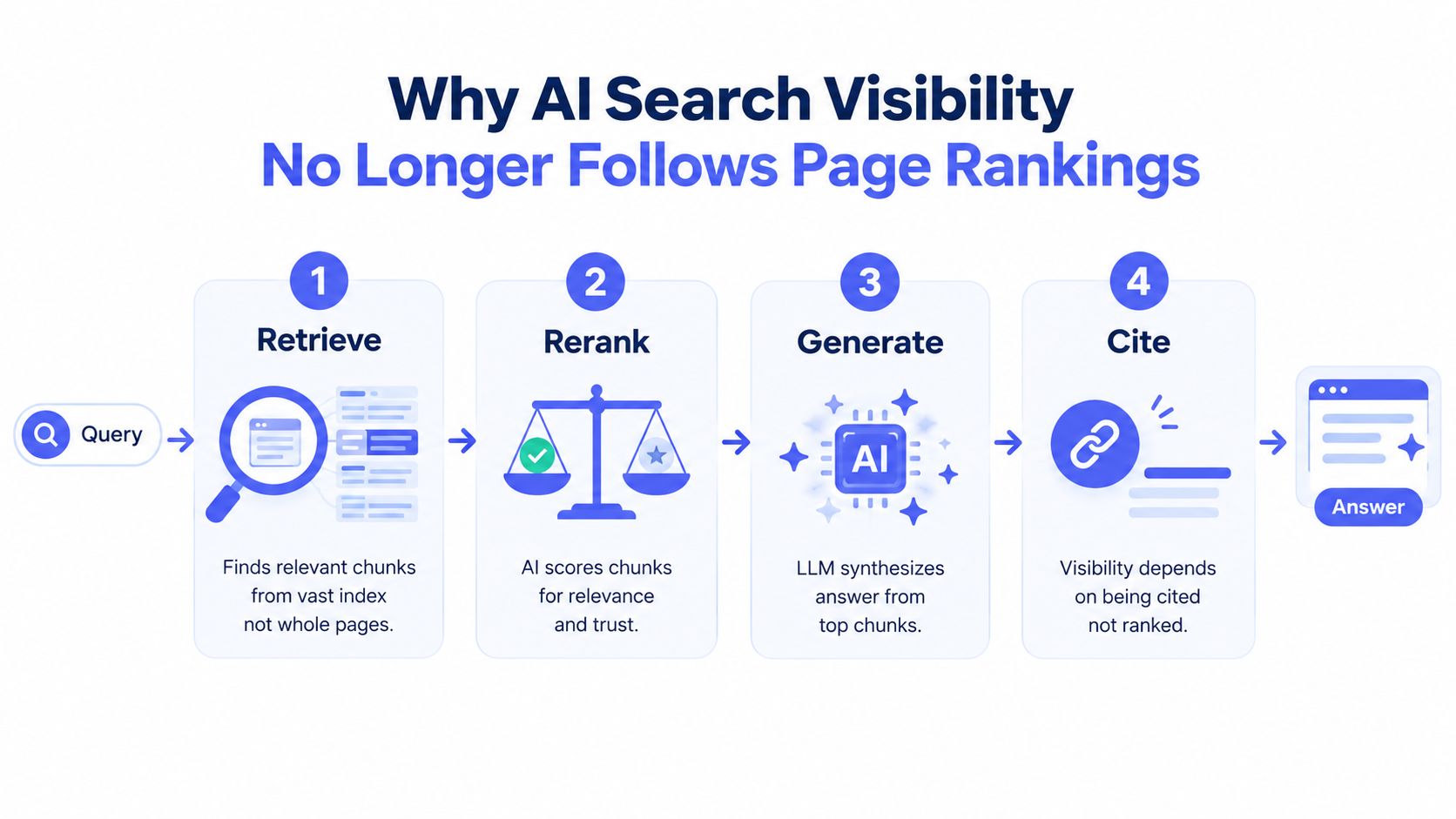
Page-level ranking creates a misleading mental model for AI search. Traditional search presents documents as results. Retrieval-augmented systems first identify candidate contexts, then score those contexts, then generate an answer from the survivors. Selection happens below the level of the webpage. The system needs to select passages that satisfy the query and provide enough context for synthesis.
The retrieve-rerank-generate pipeline changes what an audit must observe. A retriever returns top-N candidate contexts from an index. A reranker scores those candidates and retains a smaller top-k set. The generation model receives those retained contexts with the question, then synthesizes language from the available evidence. The published RankRAG mechanics document this structure explicitly, with reranked contexts concatenated with the question before final generation.
The input layer determines the answer layer
A brand that disappears during retrieval has no opportunity to appear during synthesis. A brand that enters retrieval and then loses during reranking reaches the same practical outcome. The final answer therefore measures input-layer survival. A mention or citation reveals the endpoint alone.
A useful audit separates four observations:
- Retrieve: Does a relevant passage enter the candidate set?
- Rerank: Does the passage remain competitive after relevance and trust scoring?
- Generate: Does the model use the retained evidence in its answer?
- Cite: Does the response expose the source or attribute the brand?
The distinction matters because a missing citation can sit on top of successful retrieval. The model can use a source without displaying a link, and a visible mention can rest on weak or indirect evidence. Teams tracking only answer mentions lose the diagnostic path that explains why visibility changed.
Practical rule: Measure the survival of evidence before measuring the prominence of the final mention.
Chunk-level structure controls that survival. Clear headings, direct claims, defined entities, supporting citations, and tightly connected paragraphs increase Semantic Density, meaning more query-relevant meaning exists inside a passage without requiring unrelated page context. A traditional ChatGPT rank tracker records appearances. An AI search audit explains the retrieval path behind them.
Building a Controlled Query Map That Survives Non Determinism
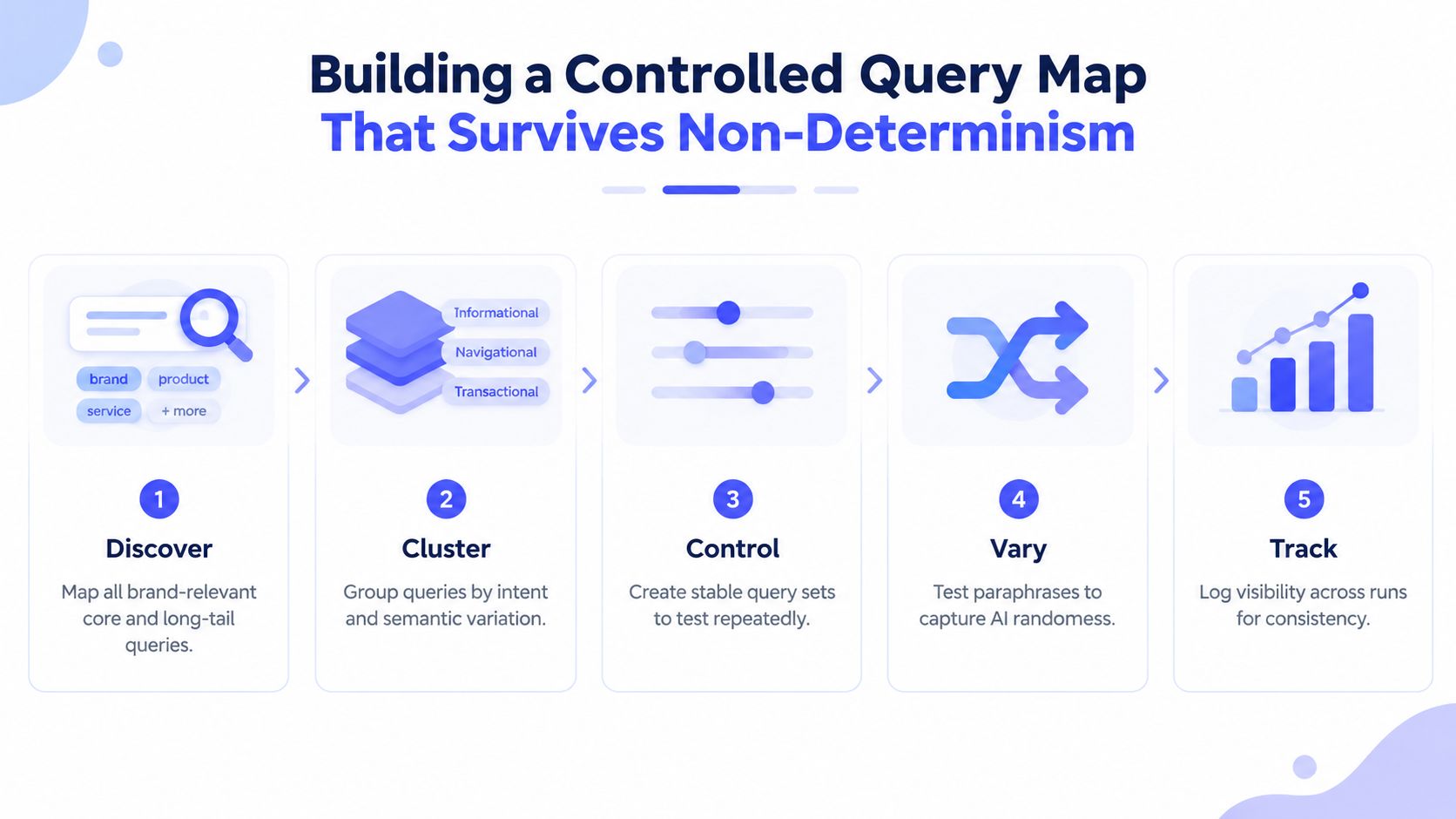
A query map is a measurement system with fixed variables and a recorded protocol. It should begin with buyer language and model the questions that shape a shortlist before a prospect chooses a vendor. Separate category, comparison, problem, local, and expert-selection intents because each one can trigger different retrieval candidates, reranking signals, and source types.
One published controlled audit methodology uses 20 to 40 brand-relevant queries across at least four platforms, reruns each query three times at different times of day, and benchmarks against three to five direct competitors. Record the platform, model or experience, date, time, exact wording, competitors named, brand position, cited URLs, and answer attributes. Add whether the brand appears in the first answer block, a recommendation, a qualification, or only a source list. Those fields help separate retrieval failure from weak answer-layer treatment.
Build the map around information needs
Start with the underlying information need, then write 3–5 paraphrases for it. “Best payroll platform for a distributed company,” “which payroll tools suit remote teams,” and “compare payroll software for a geographically dispersed workforce” test semantic stability without treating one sentence as the market.
Keep paraphrase variation separate from platform variation. A changed response after wording changes indicates prompt sensitivity. A changed response across ChatGPT, Gemini, Claude, and Perplexity indicates platform-specific retrieval or corpus behavior. A changed response across closely spaced repetitions indicates temporal or model non-determinism. Include query fan-out analysis because one user prompt can produce multiple latent searches, each with its own candidate set.
Use a structured run sheet:
- Discover the prompts. Gather unbranded category, comparison, problem, and recommendation queries from sales calls, support language, internal search, and competitor positioning.
- Cluster intent. Group prompts by the job the user wants completed, and preserve the semantic variations within each group.
- Control execution. Keep geography, audience, budget, product constraints, and output format stable unless those variables are being tested.
- Repeat the runs. Rerun prompts across platforms and time windows, then distinguish stable presence from one-off appearance.
- Benchmark the answer. Record brand presence, position, share of answer, competitor presence, source links, and factual framing.
A baseline visibility rate is the percentage of queries where the brand appears at least once. Share of answer adds positioning. A brand may appear repeatedly as a late-list alternative even as a competitor receives the first recommendation and its supporting explanation.
Prevent false positives
Track engine names, search modes, model versions, dates, domains, intent classes, paraphrases, repetitions, untreated baselines, and intervention or placebo comparisons. A 2026 GEO audit survey of the research literature identifies these controls as protection against prompt wording, temporal drift, and competitor effects.
Label each observation stable, variable, or absent. Stable presence supports work on positioning and citation quality. Variable presence points to fragile retrieval, weak authority, or prompt-dependent entity matching. Absence across controlled runs indicates a broader discovery or evidence problem. That classification keeps the audit focused on whether relevant chunks survive the pipeline.
Mapping Where AI Answers Source Their Evidence
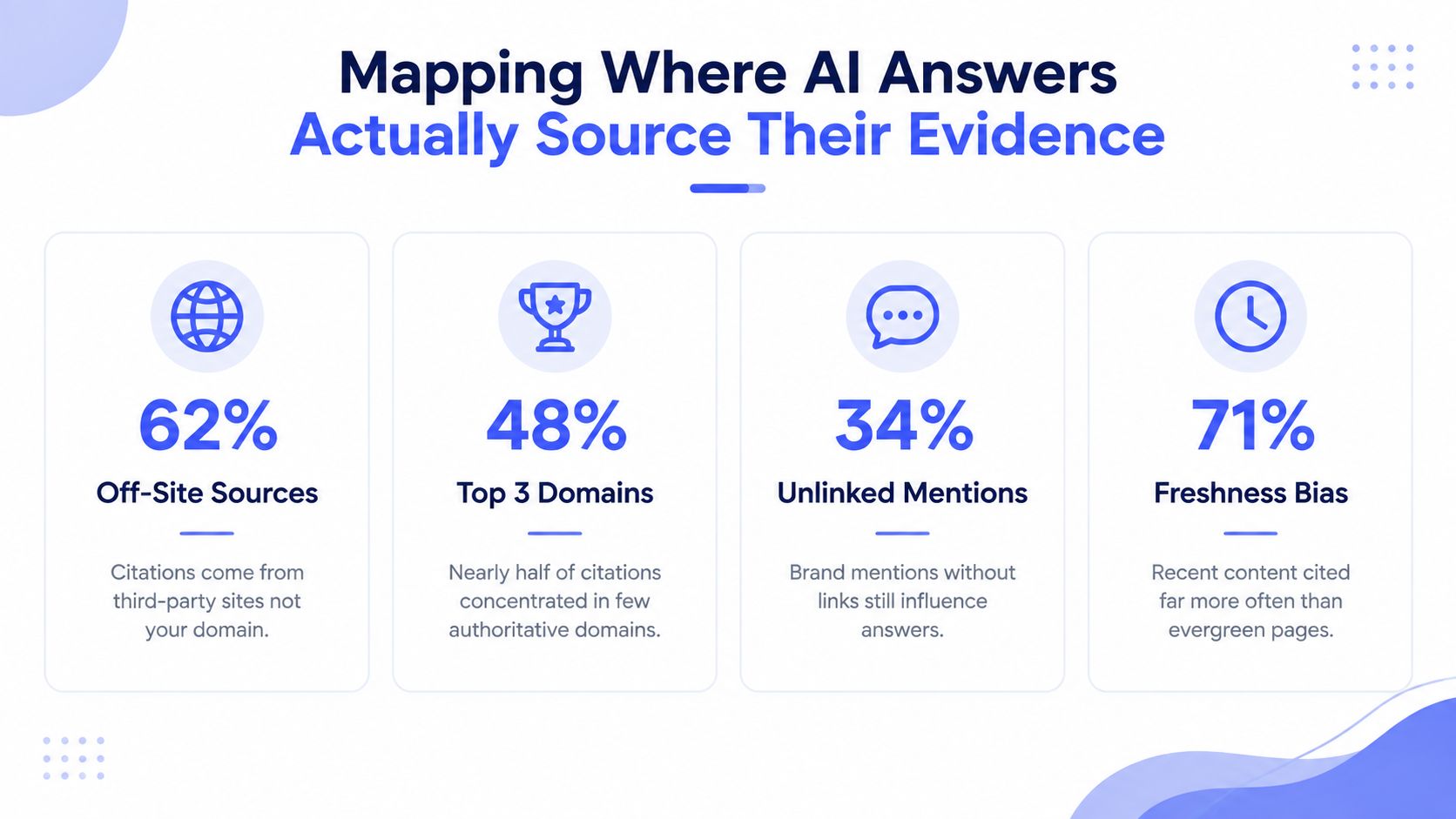
Search visibility is determined upstream of the generated answer. A page must first enter retrieval, survive reranking, and preserve enough context for the model to cite or reuse it. Citation analysis therefore reveals which sources supply the evidence layer. A brand's owned content supports factual clarity. The wider evidence environment sits outside its control. A 2026 cross-market citation study analyzed 167,551 URL-grounded citations across 128 brands, 12 home markets, and 13 languages, finding that 85.7% pointed to sites the brand does not own.
The audit question becomes operational: which external domains repeatedly provide the passages that define the category, compare vendors, and validate claims? That question is more useful than counting brand mentions, because input-layer survival determines whether the brand appears in the answer layer.
Build Evidence Clusters
An Evidence Cluster groups the domains, pages, directories, publications, reviews, and profiles that appear around one intent class. A comparison cluster may include review publications and industry directories. A local-service cluster may include professional profiles and location platforms. A regulatory cluster may include official sources and specialist commentary.
Citation distribution is concentrated. The same citation concentration findings place 80% of citations on about 18% of domains, following a Zipf-like pattern with alpha = 0.86 and R² = 0.983. The practical implication is narrow, targeted coverage of the domains that recur. Identify the domains that repeatedly survive retrieval and shape category narratives, then test whether the brand's evidence can enter those same pathways.
The audit should compare:
- Domain frequency: Which sources recur across prompts and platforms?
- Competitive citation position: Which competitor appears beside the strongest sources?
- Evidence completeness: Does a cited page support the exact claim the model makes?
- Owned-source entry: Does the brand's domain enter the candidate set for relevant intents?
- Entity framing: Do third-party sources describe the brand consistently?
A cited page can influence the model even when its context is weak or outdated. Retrieval fidelity therefore includes factual alignment alongside source count. Inspect whether cited passages preserve the brand's category, audience, differentiator, geography, and limitations.
Source discovery and answer construction are separate stages. The explanation of how ChatGPT gets its information helps distinguish them. Repeat the audit across ChatGPT, Claude, Gemini, and Perplexity, since platforms can expose different sources and citation behavior.
Treat off-site authority as an input-layer issue
Third-party coverage is part of the retrieval corpus. Its passages compete in reranking and provide language the generation model can reuse. A missing directory profile, inconsistent review description, or absent comparison page can keep the system from finding evidence that represents the brand accurately. Audits should therefore map citation sources back to the specific claims and chunks that entered the answer pipeline.
Diagnosing Retrieval Chunking and Reranking Failures
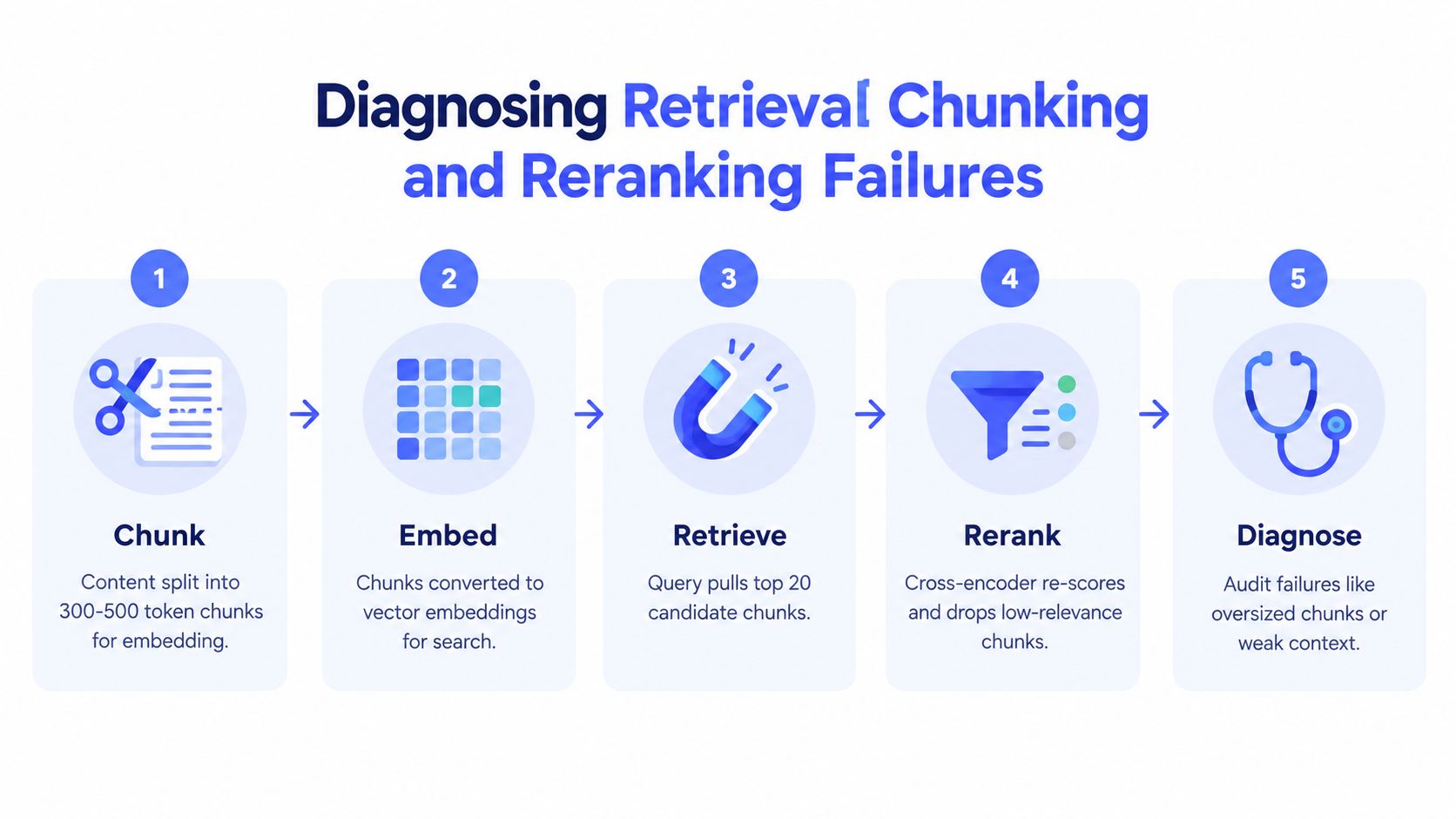
Retrieval failure frequently begins before the query reaches a reranker. A document is segmented into passages, each passage is converted into an embedding, and the query embedding is compared with those passage vectors. If a key qualification sits in one passage and the claim sits in another, the retriever can return a fragment that matches the query and still lacks the evidence needed for a reliable answer.
A 2026 segmentation study tested 36 chunking methods across six knowledge domains and five embedding models. Paragraph Group Chunking reached mean nDCG@5 of about 0.459, Precision@1 of about 24%, and Hit@5 of about 59%. That chunking benchmark found content-aware segmentation ahead of naive fixed-length splitting across every domain tested.
Inspect chunk-level structure
A technical audit should inspect whether each chunk preserves a complete answer unit. Word count does not define that unit. The relevant unit is a claim, its subject, its conditions, its supporting evidence, and its relationship to the heading.
Semantic Density rises when a passage answers one intent directly and identifies entities explicitly. Semantic Density falls when a passage opens with generic marketing language, delays the definition, mixes unrelated products, or depends on a distant paragraph for context.
The audit should test:
- Boundary integrity: Does a heading stay with the explanatory passage beneath it?
- Entity clarity: Does every passage identify the brand, product, audience, and category?
- Evidence proximity: Do citations and qualifications sit beside the claims they support?
- Extractability: Can a passage answer a prompt without surrounding page material?
- Schema alignment: Do structured fields reinforce the visible page facts?
Treat reranking as a separate gate
The retriever's candidate set differs from the generation context. A reranker reorders candidate passages and removes lower-scoring material before synthesis. The Azure semantic reranker promotes the strongest document chunks within the recall set, and RankRAG formalizes reranking as a distinct scoring stage.
That distinction produces three separate failure signatures:
| Failure signature | Likely mechanism | Audit response |
|---|---|---|
| Relevant page exists but no passage appears | Weak retrieval match or inaccessible content | Rewrite passage language around the information need and verify crawl access |
| Relevant passage enters retrieval but disappears later | Rerank weakness, ambiguity, or competing authority | Increase context completeness, entity specificity, and evidence density |
| Passage survives but answer omits the brand | Synthesis preference, answer framing, or citation behavior | Test the brand's role, claim clarity, and competitive framing |
A page-level audit misses the second row. A mention-count audit misses the first. An analyst who wants actionable diagnosis must capture candidate passages where tooling permits, then compare retrieved, reranked, generated, and cited states.
Technical remediation should begin with the highest-confidence break. Teams can use query optimization guidance to refine information needs, then apply those needs to headings, passage boundaries, internal links, schema, and supporting evidence. The objective is retrieval fidelity, meaning the right evidence survives intact from the source document into the answer context.
Turning Audit Findings Into Prioritized Remediation
Audit findings become useful only when each finding maps to a failure stage and a concrete intervention. Two issues deserve priority because generic visibility scores hide them: entity inconsistency across platforms and citation architecture that fails to connect discovery with retrieval.
Entity inconsistency appears when a professional service business describes its category, service area, specialization, or customer type differently across platforms. This is an underserved audit angle, and it surfaces where a business presents conflicting descriptions of itself across two or more platforms. Related entity consistency coverage tracks the same problem across professional services listings. The model receives competing entity signals, so the brand's identity becomes less stable during retrieval and synthesis.
Citation architecture requires a separate inventory. The analyst should map which directories, publications, profiles, schema types, and content formats appear in answer citations, then identify the missing path between a user prompt and a source passage. Broad visibility scoring cannot reveal whether a brand fails at discovery, retrieval, reranking, or citation exposure.
Use a decision matrix
| Failure Type | Example Fix | Effort | Expected Impact |
|---|---|---|---|
| Entity inconsistency | Standardize category, service, location, and specialization descriptions across owned and third-party profiles | Low | High for identity accuracy |
| Discovery failure | Secure accurate presence on authoritative directories and category publications surfaced in Evidence Clusters | Medium | High where those domains recur |
| Retrieval failure | Rebuild headings and passage boundaries around complete answer units | Medium | High for query-specific evidence |
| Rerank failure | Add direct qualifications, corroborating citations, and clearer entity associations | Medium | Medium to high for competitive prompts |
| Citation failure | Improve source architecture and create pages that support explicit, verifiable claims | High | High for answer-layer attribution |
The matrix prioritizes speed to evidence survival. A small correction across a recurring third-party profile can resolve entity ambiguity faster than publishing another owned article. A new article becomes a priority when the relevant Evidence Cluster has no reliable source for the information need.
Sequence fixes by failure stage
- Correct identity first. Align brand name, category, audience, geography, services, and differentiators across platforms.
- Repair discovery paths. Secure accurate listings and editorial references on domains that repeatedly appear in competitor answers.
- Improve source passages. Put claims, qualifications, proof, and entity names into self-contained chunks.
- Test competitive position. Rerun the controlled query map and record whether the brand enters the answer earlier, more often, or with stronger framing.
- Document the retrieval path. Link each intervention to the query, source domain, passage, platform, and observed answer change.
A broader complete site audit guide covers the foundational technical and content checks. An AI search audit extends past site health into third-party source architecture. Algomizer is a managed service provider that runs this audit for clients, measuring cross-platform brand mentions and competitor rankings, then producing an optimization roadmap its own team executes. Measurement is one half of that engagement. Remediation depends on fixing the source and retrieval conditions behind the result, and an Algomizer team carries out that work on the client's behalf.
Measuring Progress and Keeping Visibility Aligned Over Time
An AI search audit becomes reliable when the team treats every result as a dated model observation. Store the platform, model or search mode, prompt version, run time, cited URLs, answer position, competitor set, and intervention status. Version tracking prevents teams from interpreting a model change as a content improvement.
Repeated runs should use closely spaced time windows, untreated baselines, and intervention comparisons. A baseline shows natural variation. An intervention run tests whether a source or content change altered retrieval fidelity. A placebo comparison helps separate genuine movement from prompt wording or competitor effects.
A durable measurement loop includes:
- Visibility: Brand presence and share of answer across controlled prompts.
- Positioning: Recommendation order, category description, and differentiator accuracy.
- Evidence: Domains and passages cited or used across Evidence Clusters.
- Stability: Repeated appearance across platforms, paraphrases, and time windows.
- Business alignment: Qualified leads, branded demand, and revenue outcomes associated with AI discovery.
Teams reviewing specialized software categories can use resources such as RIAs explore AI tool picks to understand how recommendation contexts differ by audience and profession. The same principle applies across markets. A platform-specific answer can expose a different entity definition, source preference, or competitive shortlist.
AI visibility tracking should function as an ongoing calibration process running on a continuous cadence. Custom alerts should flag lost citations, new competitor appearances, inconsistent descriptions, and changes in high-value source domains. Headless-browser observation and independent third-party verification provide a clearer record than relying on one interface or one API output.
The strongest retention model ties continued work to retained visibility and accurate representation. Once the team knows which passages survive retrieval and which domains shape the answer, every new audit becomes a controlled test of the same mechanism.
AI Search Audit FAQ
How is an AI search audit different from a traditional SEO audit?
A traditional SEO audit checks crawlability, indexation, page speed, and ranking position for a URL. An AI search audit checks whether a passage inside that URL survives retrieval, reranking, and synthesis inside an answer engine, and which third-party domains supply the evidence when it fails. The unit of analysis moves from the page to the passage.
How many queries does an AI search audit need?
Published protocols work from a few dozen brand-relevant queries covering category, comparison, problem, and recommendation intents, each rerun several times across different hours. Coverage of the intents that shape a shortlist matters more than raw query volume.
Which platforms should an AI search audit cover?
ChatGPT, Claude, Gemini, and Perplexity at minimum, because each can retrieve a different candidate set and expose different citations for identical wording. Google AI Overviews and Copilot widen the picture where those surfaces reach the buyer.
How often should an AI search audit run?
Continuously for high-value prompts, with a full re-run after any model or index change. Answer behaviour drifts on its own, so a quarterly snapshot cannot separate a real content gain from ordinary variation.
Can an AI search audit prove that a content change worked?
Only with an untreated baseline and a placebo comparison running alongside the intervention. Record the prompt version, platform, model identifier, and date on every run, then compare treated prompts against untouched ones over the same window.
Does an AI search audit cover AEO and GEO?
Yes. Answer Engine Optimization, Generative Engine Optimization, and LLM SEO describe one problem from different angles, and a single audit covers all three when it measures retrieval survival and citation supply at every pipeline stage.
Why Algomizer Runs This Audit for You
Algomizer is a managed service provider, so the audit and the remediation sit with one team. Four things follow from that.
Full pipeline ownership: the team that identifies a retrieval failure also rewrites the passage, secures the third-party placement, and reruns the query map to confirm the fix.
Cross-platform coverage: one prompt map runs across every answer engine that reaches the buyer, so a gap on one platform never hides behind a result on another.
Outcomes-based pricing: the engagement is priced on measured visibility results, so the commercial terms follow the citation growth the client is working toward.
First-party evidence: prompt-level tracking across client accounts produces original data on which interventions move citations, and that data shapes the next audit.
About Algomizer
Algomizer is a Generative Engine Optimization and Answer Engine Optimization service provider that helps brands earn citations inside AI-generated answers on ChatGPT, Claude, Gemini, Perplexity, and Google AI Mode. Engagements are fully managed by an Algomizer team of strategists, analysts, and content engineers, with nothing for the client to license or operate.
An Algomizer team runs AI search audits that trace brand visibility across ChatGPT, Claude, Gemini, Perplexity, and other answer engines, then connects those findings to content engineering, media placement, and technical remediation delivered as a managed service. Visit Algomizer to request a complimentary visibility assessment and identify which retrieval paths are suppressing your brand.
Reviewed in November 2026 for accuracy against the evolving generative search landscape.
Written by
Myriam Aousaji
PR & Social Media Manager, Algomizer
Myriam leads PR, brand storytelling, and communications at Algomizer, the AI search optimization firm cited by Andreessen Horowitz and Entrepreneur. She runs the earned-media programs that put client brands onto the third-party pages AI engines cite, and works directly with the Algomizer Research team to translate its citation data into guidance for marketers. Her work spans the GCC, European, and North American markets, combining creative brand positioning with data-driven insight to build authority in the fast-moving AI search landscape.